

Rare Case: Fish Bone Mimicking Urachal Cancer
Most of us rarely think about what happens to a small fish bone that is accidentally swallowed. In the vast majority of cases, such sharp food remnants pass through the digestive system without causing any harm. However, rare cases show that even seemingly harmless incidents can lead to complex medical puzzles.
Fish bone migration
The authors of the case report titled “Fish Bone Migration into Urachus Mimicking Urachal Malignancy: A Rare Case Report” are Sajad Ahmad Para, Tufeel Ahmad Khan, Abdul Rouf Khawaja, Naseer Ahmad Choh, K. Gokul, and Syed Shakeeb Arsalan. As described, a 39-year-old man presented to physicians with lower abdominal pain, increased urinary frequency, and a gradually enlarging swelling below the umbilicus. Diagnostic investigations revealed a large mass extending from the dome of the urinary bladder toward the umbilicus.
Ultrasound and CT imaging demonstrated an irregular, contrast-enhancing mass suggestive of urachal carcinoma, a rare but aggressive form of cancer. According to the study first described in 1863, urachal cancer represents less than 1% of all bladder cancers. It develops in the urachus, an embryonic remnant of the urogenital sinus and allantois, which connects the dome of the bladder to the umbilicus.
Further suspicion was reinforced by cystoscopic examination, which revealed a solid growth at the bladder dome. Based on the available clinical and radiological findings, surgical removal of the mass appeared to be the only reasonable course of action.
The surprise came only after surgery
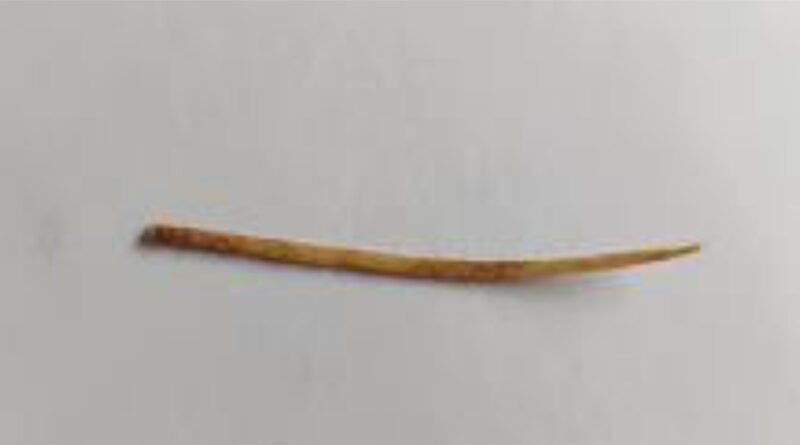
The surprise came only after surgery, when the mass was excised along with part of the urinary bladder. At the center of the specimen lay a sharp fish bone measuring approximately 2.5 centimeters in length. Histological analysis confirmed that the lesion was not malignant but instead represented a marked inflammatory reaction with a foreign-body granuloma. During a subsequent review of the patient’s history, he recalled eating fish two months earlier but had been unaware that he had swallowed a bone. It is presumed that the bone perforated the bowel and gradually migrated toward the urachus, triggering a localized inflammatory response that closely mimicked malignancy.
“Fish bone ingestion has been reported to cause bowel perforation and rarely migrate to other surrounding structures…Foreign bodies in the urachus are very rare and may present as inflammatory masses, which are difficult to differentiate from malignant pathology. Gut perforations have been reported in less than 1% of cases,” the authors wrote.
The study highlights the importance of thorough history taking, clinical reasoning, and awareness of unusual causes in medical diagnosis, even when the culprit turns out to be something as small as a fish bone.
Image: Fish bone retrieved from the specimen. Para et al., “Fish Bone Migration into Urachus Mimicking Urachal Malignancy: A Rare Case Report.”
