

Inside South Africa’s Challenge of Preparing Students for an AI-Driven Communication Industry
We are witnessing significant shifts in how we communicate, and a new study from South Africa that delves into the role of artificial intelligence illustrates just how complex this process is, especially in societies grappling with historical, economic, and infrastructural challenges.
In South Africa, communication practices are deeply rooted in social inequalities and an incredible cultural and linguistic diversity. On top of that, there are hurdles like limited access to technology, expensive internet, and an unstable electricity supply. All of this creates a demanding environment for introducing new technologies, including artificial intelligence, both in education and in daily practice. Precisely for this reason, researchers wanted to peek into how university professors, who shape future generations of professionals, perceive these changes and how they prepare students to work in such an environment.
“South African communication academics’ perspectives on variables affecting their preparation of students for an artificial intelligence-influenced industry” is a study by Lucinda Bella-May Sutton and Anette Degenaar from the School of Communication, North-West University, Potchefstroom, South Africa.
Through 15 detailed interviews with professors from ten different universities, data were collected and then analyzed to uncover key patterns and themes. The study included communication academics from various levels of seniority and experience, ranging from a junior lecturer with 0–5 years of academic experience to associate professors with more than 20–25 years in academia. Participants were drawn from ten South African higher education institutions, including North-West University, Akademia, the University of the Witwatersrand, the University of the Free State, Vaal University of Technology, Tshwane University of Technology, Rhodes University, the University of Pretoria, the University of South Africa, and the University of Johannesburg.
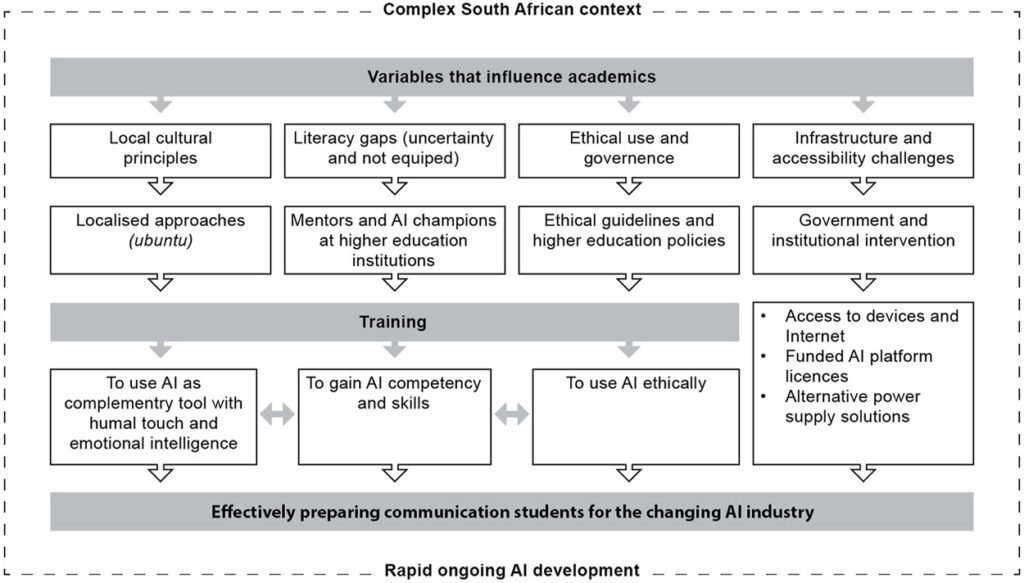
The results revealed four main factors influencing how professors prepare their students
Local Cultural Principles and the Spirit of Community. In South African society, communication is linked to the philosophy of ubuntu, which emphasizes community, mutual respect, and empathy. Professors highlighted that artificial intelligence cannot fully convey emotions and human connection, which are crucial. They believe that messages generated without a human touch can lose authenticity and warmth, becoming empty and soulless. Participant’s quote: “AI will never be able to speak to people and tell their stories, which is what we do as communicators,” and “AI gives you the bones of a message, but it cannot infuse it with warmth and with genuine care.”
Lack of Knowledge and Training. Many professors admitted that they lack experience and confidence when it comes to using artificial intelligence. This problem, unfortunately, extends to students, who often don’t get the opportunity to develop a deeper understanding and relevant skills. Study participants stressed that digital competencies must be integrated into the entire curriculum, rather than being treated as an incidental add-on. Participant’s quote: “We need to embed digital competence as a golden thread across all communication modules,” and “If we aren’t using AI ourselves, how can we prepare students to integrate it into their future careers?”
Infrastructural Challenges and Accessibility. Even when there’s a strong desire for innovation, power outages, limited internet access, and high costs make daily work difficult for both students and professors. These difficulties lead to a situation where only a part of the population has real access to modern AI-based tools, thereby deepening existing inequalities. Students from rural and less developed areas are particularly affected. Participant’s quote: “Only the most privileged in South Africa can reap the benefits of emerging technologies.”
Ethics and Governance. Participants expressed concern over vague rules and a lack of guidelines for the responsible use of artificial intelligence. Issues such as plagiarism, accuracy of information, and over-reliance on automated content are becoming increasingly important. At the same time, professors acknowledged that they themselves are unsure where to draw the line, as institutional policies are often missing or insufficiently developed. Participant’s quote: “We must not only teach students about AI, but also how to use it ethically and critically.”
Education must adapt to these conditions
Based on these findings, the study proposes several important steps. First and foremost, it is essential to develop educational programs tailored to the local context, rather than blindly adopting foreign models. Furthermore, there is a great need for continuous training for professors so they can competently transfer knowledge about artificial intelligence to students. Addressing infrastructural problems, such as internet access and a stable electricity supply, is crucial for equitable education. Finally, establishing clear ethical guidelines is vital to help students use technology responsibly.
The study concludes that preparing students for the future is not merely a technical issue; it demands a deep understanding of the broader social context. In a country like South Africa, where cultural values, social inequalities, and infrastructural challenges are strongly present, education must adapt to these conditions. Future research should include a larger number of participants and expand its focus to other African countries, as well as to students themselves, to gain a more complete picture.
Image: NWU, North West University
