

ESCAIDE 2025: Europe’s Cross-Agency One Health Task Force
At ESCAIDE 2025 in Warsaw, five European Union agencies — the European Centre for Disease Prevention and Control (ECDC), the European Food Safety Authority (EFSA), the European Medicines Agency (EMA), the European Environment Agency (EEA), and the European Chemicals Agency (ECHA) — came together to present their shared work within the Cross-Agency One Health Task Force.
In November 2025, Warsaw became the center of the European health strategy. The European Scientific Conference on Applied Epidemiology of Infectious Diseases (ESCAIDE 2025), an event organized by the ECDC since 2007, featured numerous panels and sessions. One of them sent a clear message: the future of public health in Europe lies in the unification of disciplines.
The thematic session, “Europe’s Cross-Agency One Health Task Force: From ESCAIDE 2025 to the Future of Public Health in Europe,” gathered leading experts. The session was moderated by Tyra Grove Krause (SSI, Denmark), and the panel included speakers Ole Heuer (ECDC, Sweden), Stephan Bronzwaer (EFSA, Italy), Ana Vidal (EMA, Netherlands), Ian Marnane (EEA, Denmark), Evelin Fabjan (ECHA, Finland), and Sigrid Weiland (Directorate-General for Health & Food Safety, Belgium).
We need to work together. We cannot solve this alone.
The story of the Task Force’s inception was revealed through the testimonies of Stephan Bronzwaer (EFSA) and Ole Heuer (ECDC).
Stephan Bronzwaer (EFSA) took the audience back to 2022, the period immediately following the peak of the pandemic, which coincided with EFSA’s 20th anniversary. It was a moment for looking ahead: “In 2022, we were just coming out of the epidemic, and it was the occasion of our 20th anniversary as the European Food Safety Authority, EFSA. We said let’s look forward, and let’s discuss a number of big challenges we have. So we invited our sister agencies.”
The agencies organized the ‘One Health Society Conference’ in 2022, a platform for discussing pressing issues such as vector-borne disease spread, biodiversity loss, and the challenges of transitioning to sustainable food systems. The end of that event brought a crystallization of the idea and a clear commitment: “And in the end, we came up with a very simple conclusion: We need to work together. We cannot solve this alone. No single agency can do this alone. We need each other. So, let’s start meeting regularly and form a Task Force. So, at the end of that conference, we committed to launching the Task Force.”
Laying the Foundations and Bridging the Gaps
The initiative, however, did not start from scratch. Ole Heuer (ECDC) took the floor to describe the strong foundations of cooperation that already existed: “Two of the five agencies, EFSA and ECDC, have been working very closely in the area of AMR and food-borne zoonoses for more than 15 years. Heuer cited concrete examples of this success: reports on avian influenza, as well as collaboration with EMA on the JACRA report (Joint Interagency Antimicrobial Consumption and Resistance Analysis). However, a key gap in that earlier model was highlighted: “The environment is not there, and data from the other agencies are not there either.”
This gap spurred the next phase. Bronzwaer explained that in 2023, the Task Force began with informal meetings: “In fact, it was not that formal a start. We first started meeting informally and actually asking ourselves, what is it that we can do together? What change can we really achieve?”
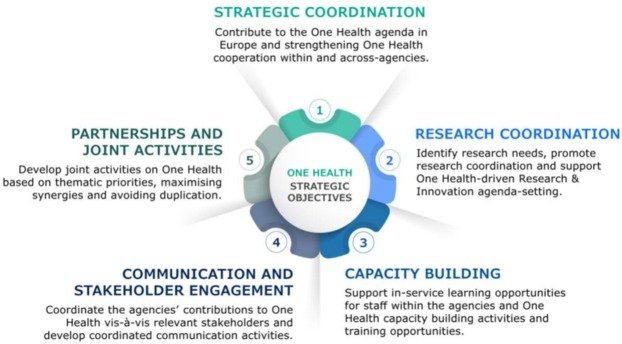
This approach led to the development and adoption of the Framework for Action in 2024, a formal document adopted by the Executive Directors of all five agencies, which sets out five strategic objectives. “Creating this Framework for Action was almost like a think tank exercise,” said Heuer.
The Framework for Action: Five Strategic Objectives
The Framework was the focus of the study that was published in December 2024, titled “The framework for action of the Cross-agency One Health Task Force.” As can be seen, the five strategic goals are: improving strategic coordination, promoting research, strengthening capacity building, encouraging communication and partnerships, as well as joint activities. In the study, the authors pointed out that key actions for the period 2024–2026 include the development of joint publications, research coordination, and training programs led by the ‘One Health’ initiative.
The Framework for Action builds on existing activities, and aims, among other things, to avoid duplication and strengthen coordination initiatives to address challenges such as: climate change; ecosystem degradation, which can create favorable conditions for the emergence and spread of infectious diseases; waterborne diseases; microplastics that enter the food chain and affect animal and human health and food safety; and also zoonoses, where the COVID-19 pandemic has shown the need for coordination across sectors.
“The European Parliament in its resolution on the COVID-19 pandemic ‘highlights the need to further expand knowledge in this field and promote public scientific research in order to better understand and reflect the interdependencies between human, animal, plant and environmental health using a multi-sectoral, transdisciplinary and integrated approach’ … Therefore, EU Agencies can help to bridge the gap between such knowledge and EU policy processes, make knowledge more accessible to relevant stakeholders…” Bronzwaer et al., 2024
EU agencies united: From staff exchange to azoles
During the session, Ana Vidal (EMA) explained how the Task Force is used to identify synergies and data needs. The most effective tool is staff exchange: “Staff exchange is a very important tool for cooperation and collaboration… we allow our staff to actually be exposed to different practices between agencies and to gain different perspectives… This is very important, of course, to enhance the cooperation in the ‘One Health’ area.”
The most concrete example of the Task Force’s success and necessity was the detailed assessment of azole fungicides, a topic presented by Ian Marnane (EEA).
Azoles are vital in human medicine for treating aspergillosis, a serious fungal infection. However, the emergence of azole-resistant Aspergillus reduces the effectiveness of human therapy. Resistance develops through two pathways: the patient pathway (during therapy) and the environmental pathway (after exposure to azole fungicides).
The joint agency assessment revealed that the environmental resistance selection pathway is, in fact, a quite significant contributor to the development of resistance. As concluded in the joint report, which was supported by the Joint Research Centre (JRC), Azoles are vital medicines for treating diseases caused by the Aspergillus fungus, but their widespread application outside human medicine in the EU/EEA, especially as plant protection products (PPPs), proved to be the main source of concern.
Data show that between 2010 and 2021, approximately 120,000 tonnes of azoles were sold for non-medical use, the majority of which (over 119,000 tonnes) were used for plant protection. A rough comparison for 2021 revealed that the quantity of azoles consumed in agriculture and other sectors was approximately 1,000 times greater than the quantity of triazoles and tetrazoles consumed in human medicine. This imbalance creates strong resistance selection pressure in the environment, leading to the conclusion that azole use outside the human domain is very likely to contribute to the development of azole-resistant strains that can cause severe diseases like invasive aspergillosis in humans
Marnane concluded: “This is not an issue that is fully within the remit of a single agency. So, in this case, there is a very clear requirement or very clear benefit for all agencies to work together to actually investigate this and assess… where this azole resistance is actually coming from.”
A necessity in a world exposed to numerous complex challenges
We can conclude that the benefits of this cooperation extend far beyond Europe, as it facilitates a better understanding of the problem as a whole, rather than merely its individual components—a necessity in a world exposed to numerous complex challenges. In other words, the vision was confirmed in Warsaw: Through the unified strength of its agencies, Europe has committed to an approach that guarantees more resilient and safer public health for all its citizens and ecosystems.
Image: ESCAIDE 2025
