

Veterans Have Scientific Evidence Linking Agent Orange to Myelodysplastic Syndrome
More than sixty years after Agent Orange first blanketed the jungles of Vietnam, science has finally confirmed what thousands of veterans have felt firsthand. A new national study in 2025 has, for the first time, linked Agent Orange to the development of myelodysplastic syndrome (MDS), a serious bone marrow disease that often precedes aggressive leukemia. Presented at the 2025 annual meeting of the American Society of Hematology (ASH), the research provides a scientific basis for recognizing the rights of veterans who have long been in a “gray area.”
The study was co-led by researchers at Sylvester Comprehensive Cancer Center, part of the University of Miami Miller School of Medicine. Authors of the study are Mikkael Sekeres, Amy DeZern, Michael Otterstatter, Eric Padron, Tareq Al Baghdadi, James Foran, Rami Komrokji, Gregory Abel, Wael Saber, Steven Gore, Cecilia Lee, Rafael Bejar, Jijun Liu, Joachim Deeg, Seth Sherman, R. Coleman Lindsley, Nancy DiFronzo, Matthew Walter, and Nancy Gillis.
We spoke with Mikkael Sekeres, M.D., M.S., Chief of the Division of Hematology and Professor of Medicine at the Sylvester Comprehensive Cancer Center, about the groundbreaking study linking Agent Orange to myelodysplastic syndrome (MDS).
The result of a personal mission by Dr. Mikkael Sekeres
This study is the result of a personal mission by Dr. Mikkael Sekeres, one of the leading global hematologists. “I see veterans who develop these conditions and need expensive medical care, but I can’t write a letter that establishes causality because, before this study, we hadn’t clearly linked Agent Orange to MDS,” said Dr. Sekeres. Analyzing data from over 2,100 patients, Dr. Sekeres’ team found that, in exposed veterans, the disease develops at a younger age, carries more severe genetic mutations, and the likelihood of progression to leukemia is nearly twice as high within the first two years. According to the study among 2115 enrolled patients, 1191 (56%) had a myeloid malignancy or precursor condition, and 130 (6.1%) reported AO exposure; the majority (96%) were male.
“In our representative national cohort of patients with at least one cytopenia, and for the first time, we demonstrated that AO exposure is associated with younger age at MDS diagnosis, ultimate MDS diagnosis, genetic complexity of MDS, increased risk of disease progression, and with Black race, despite Black individuals comprising just 16% of men who served in the Vietnam War and being less likely to have MDS than white individuals. AO should formally be recognized as a risk factor for the development of MDS,” they concluded in the study.
“Just a form of anemia”
In many cases, the Board of Veterans Appeals admitted a veteran’s MDS was service-connected but still denied benefits by claiming it was ‘just a form of anemia.’ By mislabeling a life-threatening bone marrow cancer as a minor deficiency, they ruled that veterans were not ‘disabled’ enough to receive compensation.
“I felt as if my hands were tied…”
Do you remember the day you decided to start this research?
Dr. Mikkael Sekeres: I have cared for veterans who were exposed to Agent Orange and subsequently developed myelodysplastic syndromes for my entire career. The very first veteran I saw was early in my career as an attending physician. I remember that, despite the likelihood that his myelodysplastic syndrome was caused by Agent Orange, I felt as if my hands were tied in describing that causal link in his medical record. I feel much more comfortable doing so now.
How will this study directly help people, and what do you think is key to driving change? Your study also indicates that there is not enough research in this area. I think that the study highlights, on several levels, not only shortcomings but also gaps in knowledge. Which two important directions can this study point to for further research?
Dr. Mikkael Sekeres: Before embarking on therapy, most of my patients want to explore what possibly could have caused their cancer, to feel comfortable with risk factors they might have avoided, and can advise friends and family to avoid, and which risk factors were unavoidable. This study establishes that Agent Orange exposure in veterans who served in the Vietnam War is a risk factor for a specific cancer, myelodysplastic syndromes. This will help patients in establishing a cause for their cancer, and also will help in preventing similar exposures in the future, thus preventing other cases of myelodysplastic syndromes. In the future, we’d like to explore the link between Agent Orange exposure and genetic mutations at a deeper level, and also explore any other potential large databases that include information about both Agent Orange exposure and the development of other cancers.
How can these findings help us in studying the potential risks of modern chemicals?
Dr. Mikkael Sekeres: Many cancers, and myelodysplastic syndromes in particular, arise when a number of genetic mutations occur over years or even decades. More and more, we are identifying patients who develop that very first mutation, and have started clinical trials of drugs to help prevent that very first mutation from progressing to frank cancer. I suspect that we will be better at identifying those initial mutations, and thus identifying the likely cause of the initial mutation, such as specific environmental exposures, so that we can minimize or eliminate exposure to those toxins in the future.
A strong support for those who have waited too long
An estimated 2.6 million U.S. service members may have been exposed to Agent Orange during the Vietnam War. For decades, research has shown that exposure increases the risk of several types of blood cancer, including lymphoma, multiple myeloma, and leukemia. Now, for the first time, this study has established a clear link to MDS. The findings are a voice of truth for thousands of veterans and a strong support for those who have waited too long.
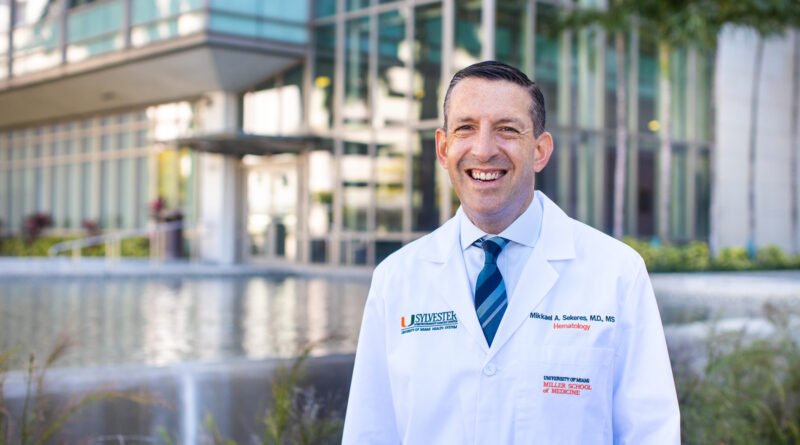
Image: Dr. Mikkael Sekeres, Sylvester Comprehensive Cancer Center.
