

Sex Differences in Animal Lifespans
Females of many species live longer than males, for example, female gorillas. In fact, the world’s oldest gorilla in captivity is a female, Fatou, who celebrated her 68th birthday this year. However, this rule is not strict, and there are exceptions, such as birds or insects.
In the study Sexual selection drives differences in adult life expectancy across mammals and birds, an international team led by scientists from the Max Planck Institute for Evolutionary Anthropology presented the results of the most comprehensive analysis of lifespan differences to date. Using data on adult life expectancy from 528 mammal and 648 bird species in zoos, the researchers gained new insights into why males and females age differently. To see if the same patterns held in the wild, the researchers examined previously published data on 110 species, 69 mammals, and 41 birds that had also been monitored in zoos.
We asked the lead author, Dr. Johanna Stärk of the Max Planck Institute for Evolutionary Anthropology, how these findings could help in developing better animal protection strategies.
XX vs. XY
In mammals, females have two XX chromosomes, while males have one X and one Y, making them the heterogametic sex. Some studies suggest that two XX chromosomes protect against harmful mutations, which may help females. In birds, the scientists point out, females have one Z chromosome and one W chromosome (making them heterogametic sex), and males have two ZZ chromosomes.
The results presented in the study confirm this hypothesis: in most mammals, 72% of females lived longer, about 12% longer. In contrast, in most bird species, 68% of males lived longer by about 5%. However, that’s not the whole story. Reproduction also plays a role in this. In polygamous mammals, males live shorter, while monogamous males live longer. The reason is, for example, lower competitive pressure. Among primate parents, females often survive until their offspring become independent or reach sexual maturity.
It should also be noted that there is also the idea that environmental pressures may influence why males and females often live different life expectancies. To investigate this, they also looked for answers in zoos, where these pressures are largely absent. The results showed that the differences did not disappear; that is, females and males still tend to have different life expectancies, although the differences were somewhat smaller.
As noted in the study, their findings may help explain why differences in adult life expectancy between men and women are so consistent across time and cultures. “Specifically, female-biased adult life expectancy appears to be common to chimpanzees and gorillas, suggesting that longer life expectancies for females are a characteristic long embedded in our evolutionary history. Intriguingly, though, the female adult life expectancy advantage in humans is smaller than that observed in African apes, including previously studied populations of chimpanzees and gorillas in the wild,” the study reports.
What does this mean for conservation?
How can this help in developing better animal protection strategies? Can it also tell us something about how different sexes in the animal kingdom adapt to climate change?
Johanna Stärk: Our focus was not on developing improved animal protection strategies, but on testing evolutionary hypotheses to better understand aging processes. Nevertheless, understanding sex-specific aging and survival patterns in zoo animals can help fill critical knowledge gaps for threatened species, many of which lack demographic data in the wild. Information such as life expectancy, age at maturity, and how these traits vary across environments can inform sex- and age-specific care and management plans for both ex situ (zoos and aquariums) and wild populations. Additionally, insights into aging patterns in zoos can guide welfare strategies for aging populations, such as developing targeted geriatric care for animals under human care. We did not assess how changing climates or other threats differentially affect sexes or population viability. However, understanding how demographic traits such as life expectancies differ between sexes and vary across environments provides critical baseline data that are still lacking for many species, which could ultimately help predict how different sexes might respond to environmental changes.
What surprised you the most, and what is your main question now?
Johanna Stärk: One surprising finding was notable exceptions to the usual patterns of female advantage in mammals and male advantage in birds. For example, in birds of prey, females are both larger than males and live longer, and often defend their territories, contrasting with the typical sex roles and the male-biased life expectancy seen in many other birds. The reasons for these exceptions remain unclear and are an interesting avenue for future study.
Our main question now is: what physiological processes underlie sex differences in aging? So far, we have focused on evolutionary hypotheses, but linking these to physiological processes, such as immune function and disease patterns, is a key next step. For example, in humans, men often die from cardiovascular or infectious diseases, while women more often have chronic or autoimmune conditions. We aim to see if similar patterns exist in other mammals and birds, using zoo veterinary records as a valuable resource.
“We dedicate this manuscript to the memory of the late James W. Vaupel.”
Professor James W. Vaupel was one of the world’s leading scientists and the founder of several demographic institutions, including the Max Planck Institute for Demographic Research (1996). He co-founded the European Doctoral School of Demography (EDSD) in 2005 and, in 2009, Population Europe.
“We dedicate this manuscript to the memory of the late James W. Vaupel, whose ideas were fundamental to this research,” the authors stated in the study.
From Fatou to Wisdom
With a wingspan of about 2 meters, a Laysan albatross named Wisdom was first tagged in 1956, when she was about five years old. She is also the world’s oldest known wild bird. Late last year, at the age of 74, she laid an egg at the Midway Atoll National Wildlife Refuge in the Pacific Ocean. This study, along with the ages of Fatou and Wisdom, reminds us of the importance of understanding sex differences, their impact on longevity, and their importance for conservation.
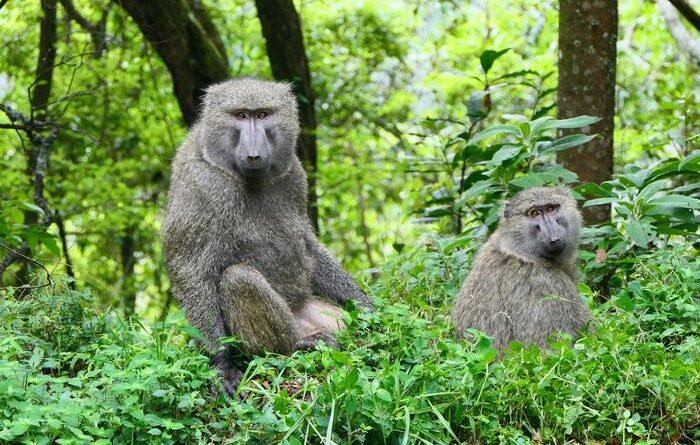
Image: Male and female olive baboons (Papio anubis) in the Bwindi Impenetrable Forest. Photo by Martha Robbins.
