
Vrije Universiteit Brussel in 2025: A Year of Scientific Breakthroughs and Social Responsibility
The year 2025 was significant for Vrije Universiteit Brussel (VUB); through the combination of science and humanistic values, VUB demonstrated how the academic community responds to the most complex challenges of modern society.
Restoring Fertility and New Hope
January 2025 will be remembered in the history of medicine. Research teams from VUB and UZ Brussel performed the world’s first transplantation of cryopreserved (frozen) immature testicular tissue in a patient who had undergone chemotherapy during childhood. For the first time, the tissue was reintroduced after 16 years of storage with the goal of initiating sperm production. This achievement was not accidental; UZ Brussel was the first institution in the world to launch a cryopreservation program back in 2002, and this procedure represents the culmination of decades of pioneering work.
Meanwhile, Dr. Lisa Ramaut from the Department of Plastic, Reconstructive, and Aesthetic Surgery at the University Hospital of Brussels (UZ Brussel) researched the use of stem cells derived from adipose tissue for wound healing and scar formation. “Traditionally, stem cells have primarily been taken from bone marrow or umbilical cord blood, both relatively difficult to obtain sources. In 2001, it was discovered that adipose tissue contains not only fat cells but also mesenchymal stem cells – support cells that function as stem cells in cases of tissue damage. This provided a much more accessible alternative for stem cell therapies. In my research, I specifically focused on the impact of these stem cells on wound healing and scar formation. We conducted clinical experiments in which surgical wounds were treated with stem cells derived from adipose tissue, known as Nanofat,” Dr. Ramaut said.
The study showed that Nanofat has a positive effect on the early stage of scar maturation, and future research is important to fully map the potential of these stem cells.
The Climate in Science Is Not Always Pleasant: Warnings from a Climatologist
Climatologist Prof. Wim Thiery drew attention in 2025 regarding the U.S. withdrawal from the Paris Agreement. Professor Thiery emphasized: “The USA is already severely affected by climate change, with rising sea levels threatening its coasts, more intense hurricanes, and an increasing number of wildfires, as evidenced by the recent fires in Los Angeles. A VUB study calculated that the area affected by these wildfires has already increased by 42% in recent years. And the affected land area will continue to grow in the coming years.” Professor Thiery warned that achieving climate agreements at the international level will become significantly more difficult now that one of the biggest players is turning its back on climate negotiations
Yet scientists always have a trump card, as shown by the FULL-MAP project, in which VUB participates, a revolutionary initiative under the Horizon Europe program. The project aims to accelerate the development and application of next-generation materials and batteries, pushing Europe to the forefront of sustainable energy solutions.
Security and Geopolitics: Scenarios for Europe
VUB researchers Luis Simón and Lotje Boswinkel described four scenarios for the future of the presence of American troops in Europe. They stressed that Europe would have to invest in its own intelligence, surveillance, and reconnaissance capabilities, long-range weapons, missile defense, and the ability to deploy large-scale forces without US support. While a certain degree of technological dependence on the US will remain inevitable, European countries must make strategic choices: where should they duplicate American capabilities, and where should they merely complement them.
In contrast to political division, science chose unity. VUB and ULB established BruPaCT (Brussels Pancreatic Cancer Team), in collaboration with UZ Brussel and the University Hospital of Brussels (H.U.B.) – Hopital Erasme / Institut Jules Bordet. BruPaCT is the first joint Belgian team for pancreatic cancer research. “Due to the critical needs of patients, we must think bigger and act faster; it would be a shame not to combine our resources and knowledge,” said Prof. Dr. Ilse Rooman, Head of BruPaCT at VUB and Principal Investigator at the Translational Oncology Research Centre at VUB. This is particularly important as pancreatic cancer affects approximately 1,500 people annually in Belgium, including a growing number of younger patients.
“Science in Fashion” and Biotechnological Solutions
That science is also part of fashion has been demonstrated by a microbiology research group that has created the first bio-based handbags made from mycelium leather. Led by Prof. Eveline Peeters and Prof. Elise Vanden Elsacker, the team investigates mycelium, the root structure of fungi, as a sustainable alternative to animal and synthetic leather. “As the field of biofabrication develops, we are gradually redefining what it means to design products. In our lab, we collaborate with living organisms to create materials that challenge traditional notions of matter. By working with fungi and their natural ability to grow structures, we can create materials that are shaped by life itself,” said Prof. Elise Vanden Elsacker.
Care for the Vulnerable: From Infants to the Elderly
VUB scientists have highlighted the importance of thickeners in baby food. A study led by Prof. Eline Tommelein from the Experimental Pharmacology Research Group at VUB has shown that thickeners vary greatly in terms of preparation and effectiveness. Certain thickeners, such as starch, lose their effect in the acidic environment of the stomach, and others work better in an acidic environment; some thickeners need to be prepared in advance, while some can be used immediately. “With sodium carboxymethylcellulose (‘Gelilact’), babies consume up to three times the recommended amount of salt. When starch is used, the calorie content of the food increases significantly, which can lead to rapid weight gain,” said Prof. Tommelein. She explained that healthcare professionals must have a thorough understanding of the composition and effects of these products, and that parents need accurate and specific guidelines.
A study that has further enriched the world of medicine is the research of Dr. Aziz Debain from the Department of Research on Frailty and Resilience in Aging, Department of Geriatrics at VUB, and UZ Bruxelles, which examined the impact of drugs on the autonomic nervous system in the elderly. The two-year study included 400 participants and showed that certain drugs almost triple the risk of frailty in the elderly. “Our study shows that older people who take drugs that affect the autonomic nervous system are almost three times more likely to become frail compared to their peers who do not take these drugs. We also found that many of these drugs have not been specifically tested in people over 80 years of age, although they are often prescribed to them,” said Dr. Debain.
Deep Past, Pain, and Math
VUB research spanned from the deserts of Iraq to quantum physics:
Dr. Ella Egberts discovered seven Paleolithic sites in Iraq, collecting over 850 artifacts, including hand axes up to 1.5 million years old. “Our targeted fieldwork resulted in the discovery of seven Paleolithic sites in an area of 10 x 20 km. One location was selected for systematic research in order to determine the spatial distribution of Paleolithic material and conduct preliminary technological and typological analyses,” Dr. Egberts said.
Dr. Giorgio Arriga’s geoscience team analyzed faults in Italy (Pettino and Paganica), using uranium–thorium carbonate dating to demonstrate their structural connection, crucial for predicting future destructive earthquakes. “Our team analyzed the spatial interactions between different active fault segments in the L’Aquila Basin over time, in particular the Pettino and Paganica faults. Although these faults appear to be unrelated on the surface, seismic data suggest otherwise. Our field investigations and geochemical analyses provided evidence for a structural connection between these active faults. Using uranium-thorium-carbon dating, in collaboration with laboratories in Taiwan, we were able to establish geological time constraints on this connection. Our discovery has significant implications for seismic hazard assessments, as connected faults can generate larger and more destructive earthquakes. By understanding how faults have evolved, we can better predict their future activity and contribute to safer urban planning in Central Italy and beyond,” Dr. Arriga explained.
In 2025, Pieter Martens, associate professor of the history of architecture at the Vrije Universiteit Brussel (VUB), pointed out that the hunger for news images is centuries old and that visual journalism turned exactly 500 years old in 2025. “On February 24, 1525, the famous Battle of Pavia took place. French troops besieging the northern Italian city were crushed by the auxiliary army of Emperor Charles V. The crème de la crème of the French nobility died on the battlefield, and the French king was captured. Charles V himself was not present in Pavia that day – coincidentally on his 25th birthday – but the glorious victory of his troops over France’s greatest rival strengthened his power in Europe and was widely celebrated and highlighted – literally. It was the first news event ever depicted on a large scale through graphics and paintings,” Professor Martens said.
Dr. Leandro Vendramin was awarded for solving the complex Yang-Baxter equation, using abstract algebraic structures to understand particle interactions in quantum physics.
When it comes to living without chronic pain, the Stimulus research group at the Vrije Universiteit Brussel (VUB) is taking care of it. In 2025, they received prestigious funding from the Research Foundation Flanders (FWO) to further expand their groundbreaking research into chronic pain. “Severe chronic pain can be completely debilitating. Patients struggle to sleep, work, or enjoy their social life. They feel trapped in their own bodies,” said Prof. Dr. Maarten Moens, co-founder of Stimulus.
Global Prestige and Infrastructure
Scientists received additional support through the Sofia (Tier-1) supercomputer, which will accelerate research for the next six years. Four VUB researchers: Prof. Jan Steyaert, Prof. Joeri Van Mierlo, Prof. Maitane Berecibar, and Dr. Chris Smith, were ranked among the 1% most cited worldwide. Prestigious ERC grants were also awarded to Prof. Eva Swyngedouw, Prof. Willem Staels, and Dr. Tom Dendooven.
Commitment to the Future
The achievements of 2025, from historic medical breakthroughs and environmental initiatives to the educational PACT School Tour, demonstrate that Vrije Universiteit Brussel’s commitment extends far beyond laboratories and publications.
This engagement with society was strongly illustrated by the third edition of the PACT School Tour, launched by VUB Rector Jan Danckaert at the Atheneum Caroline Pauwels. The tour, which ran from February to the end of May 2025, brought VUB professors directly into secondary schools to inspire students and strengthen their critical thinking skills. Rector Danckaert opened the tour with a guest lecture entitled “What Is Light?” at the Atheneum Caroline Pauwels, a highly symbolic location named after the former VUB Rector whose vision continues to inspire the university’s values. During his address, Danckaert emphasized that “Critical thinking is not a subject, but a way of life.”
“In a world where we are constantly inundated with information, it is crucial that young people learn to distinguish between what they hear, see, and believe. Caroline Pauwels understood better than anyone how important this is,” he said.
May 2025 was also marked by the VUB’s strong stance on freedom of expression and press freedom. During a sunny spring ceremony in Bozar on May 2, the Honorary title of Freedom of Expression 2025 was awarded to Rwandan investigative journalist Samuel Baker Byansi and the Italian investigative platform IRPI (Investigative Reporting Project Italy). The award was jointly presented by the rectors of the VUB and ULB in recognition of their courageous and persistent efforts to expose abuses of power, often in the face of serious threats. As VUB professor and academic director, Ike Picone stated, “They have been exposing abuses for years, despite threats from authorities and powerful groups.”
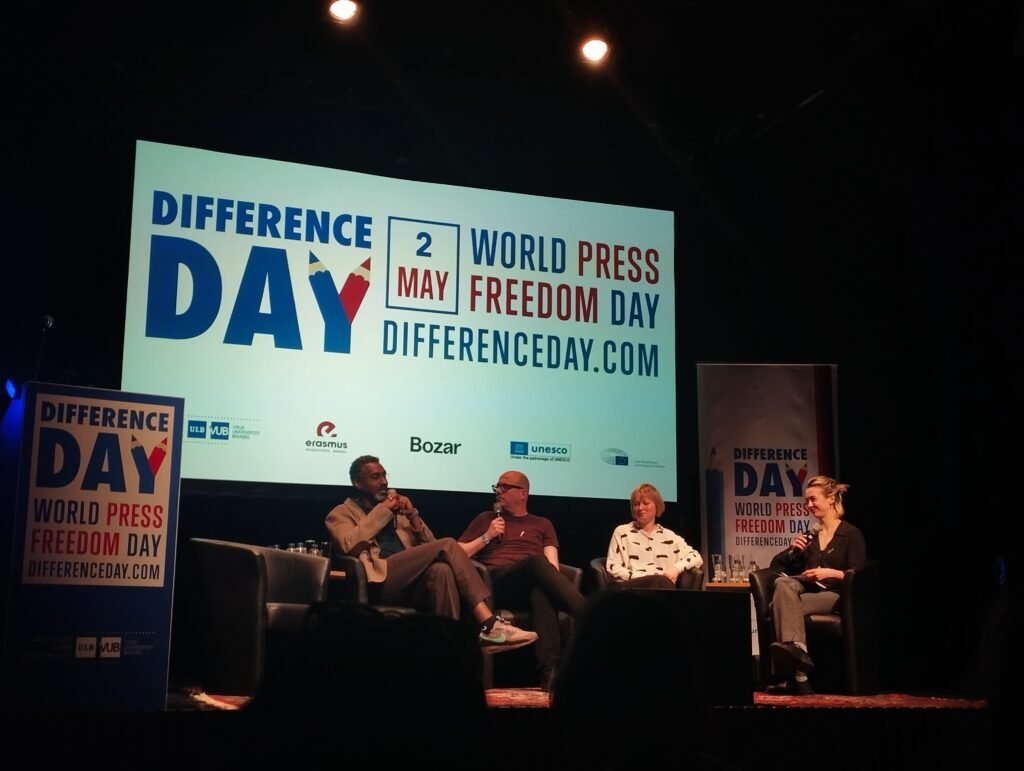
One of the speakers on Difference Day 2025 was Khalid Albaih, a renowned Sudanese political cartoonist and civil rights activist whose work embodies the power of art and journalism in defending democratic values. Together, these initiatives underscore Vrije Universiteit Brussel’s commitment to knowledge that empowers and defends fundamental freedoms. Whether through inspiring students, supporting investigative journalism, or fostering critical thought, Vrije Universiteit Brussel reaffirmed its role as a socially engaged university in 2025.
The year was also marked by numerous doctoral defenses, which demonstrated the academic excellence and potential of the students, as well as by numerous other scientific research projects. In his New Year’s speech, VUB Rector Jan Danckaert announced a renewed candidacy but also emphasized that there is still a lot of work to be done, for example, in attracting more students to STEM and health programs and in further expanding the university’s organization.
All images by the author.
These publications were produced as part of the Maria Leptin EMBO Fellowship, which allowed us to spend two months exploring the world of science at VUB in Brussels. Importantly, all articles were the result of our own choice of topics and in accordance with our interests.
