


A parasite that feeds on tears has been detected in Estonia for the first time in a dog
Veterinarians in Estonia have reported the first molecularly confirmed case of infection with the ocular parasite Thelazia callipaeda in a dog, indicating the spread of this zoonotic nematode into northern parts of Europe.
The parasite, known as the “oriental eyeworm,” is transmitted by a small fruit fly that feeds on the tears of animals and humans. In Europe, its primary vector is Phortica variegata. Over the past two decades, T. callipaeda has expanded from its original range in Asia to much of Europe, including southern and central regions, as well as parts of western Europe.
The case was described in an article titled “First molecularly confirmed case of canine thelaziosis due to Thelazia callipaeda infection in Estonia” by Kristi Sisask, Maare Mõtsküla, and Urmas Saarma.
“Thelazia callipaeda, commonly known as the “oriental eyeworm”, is a zoonotic vector-borne nematode first described in Asia in the early 20th century. In recent decades, T. callipaeda has been increasingly reported across Europe, including in Turkey, Romania, Bulgaria, Greece, Serbia, Hungary, Slovakia, Poland, the Czech Republic, Austria, Croatia, Bosnia and Herzegovina, Germany, Switzerland, Italy, France, Belgium, Spain, Portugal, and the United Kingdom. The parasite infects a range of domestic and wild carnivores (e.g., dogs, cats, red foxes, wolves, beech martens), lagomorphs, and humans…The primary vector for the eyeworm in Europe is the male fruitfly Phortica variegata, which feeds on lacrimal secretions. Adult female worms release first-stage larvae (L1) into the host’s lacrimal secretions. Vector activity peaks from spring to late autumn, with optimal conditions at 20–25 °C and 50–70% relative humidity.” Sisask et al., study on canine thelaziosis in Estonia.
The case was identified in a six-year-old spayed female Swiss White Shepherd dog that had travelled through multiple European countries during the summer of 2024, including Italy, Germany, Austria, and Poland. In November, the owner noticed tearing and redness in the left eye. A veterinary examination revealed motile, thin worms in the conjunctival sac and beneath the third eyelid.
A total of eight worms were removed under local anaesthesia using cotton swabs…
“The treatment involved manual removal of nematodes and oral administration of milbemycin oxime/praziquantel twice, with 1 week interval in combination with topical lubrication. Follow-up examinations revealed significant improvement in ocular health, with no further signs of infection. The right eye showed no pathological changes, and no nematodes were detected,” the authors described.
Although the infection was most likely acquired during travel to endemic regions, the case highlights the risk of further geographic expansion. Climatic conditions favourable for vector development, temperatures between 20 and 25 °C, and moderate humidity, are increasingly present across much of Europe during warmer months, raising the possibility of local transmission cycles becoming established.
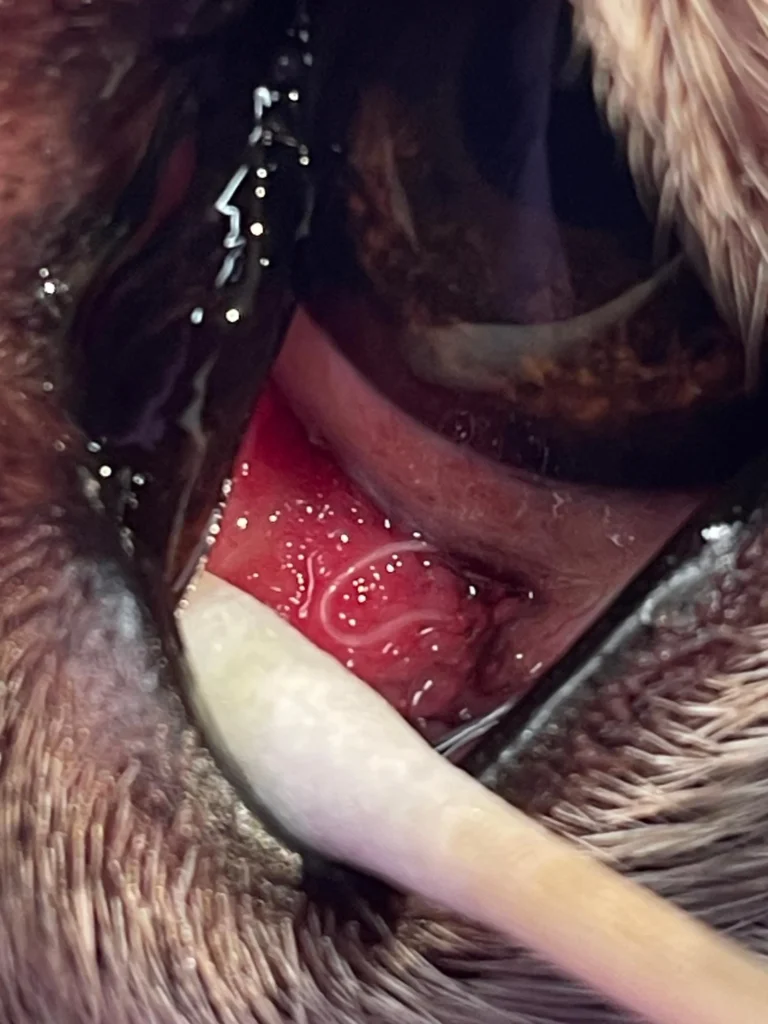
Clinically, infection in dogs most commonly presents as conjunctivitis, purulent discharge, excessive tearing, and ocular irritation, and in more severe cases may lead to corneal damage. In humans, symptoms are similar and include foreign body sensation, photophobia, and conjunctival inflammation. Treatment is based on mechanical removal of visible parasites and administration of antiparasitic agents targeting larval stages, preventing recurrence. Preventive measures, particularly for travelling pets, are considered essential.
“In Europe, licensed treatments for canine thelaziosis include a topical spot-on formulation containing moxidectin 2.5% (combined with imidacloprid 10%), as well as an oral formulation of milbemycin oxime. Moxidectin-based products have shown high efficacy in treating and preventing T. callipaeda infection. However, adverse weather conditions, such as wet weather causing damp haircoat, may reduce the effectiveness of topical applications.” Sisask et al., study on canine thelaziosis in Estonia.
This Estonian case, therefore, underscores a broader public health message: increased pet travel and climate change are creating conditions that facilitate the spread of parasites previously limited to restricted geographic areas. Veterinary and medical communities are urged to maintain heightened vigilance and improve early detection. “Awareness of the parasitic aetiology is especially important in non-endemic regions, where T. callipaeda may not be considered among differential diagnoses of conjunctivitis. Obtaining a thorough travel history remains crucial for early diagnosis and appropriate management… Enhanced surveillance and One Health collaboration among veterinarians, entomologists, wildlife biologists, and the public health sectors will be critical to address this emerging parasitic threat,” they concluded.
Image: White_Swiss_Shepherd_Dog, Durdur31
