


First Study of VR Avatar Therapy for Hearing Voices in Central and Eastern Europe Shows Promising Results
For people who hear voices that others cannot hear, everyday life can become a struggle. These voices may insult, threaten, or issue commands, while the feeling that they have power over the person hearing them can intensify fear and distress. Researchers are now investigating whether virtual reality could help people change their relationship with these voices by giving them a face.
Together with a therapist, the patient creates a digital character representing the voice they hear. The aim is not simply to silence the voices, but to help the person confront them, reduce their perceived power, and develop a greater sense of control.
A new international study involving people with schizophrenia and auditory hallucinations examined an enhanced version of this therapy, combining virtual reality with elements of cognitive behavioural therapy (CBT) and acceptance and commitment therapy (ACT). The research involved partners from Spain, Poland and Hungary. It is the first study of this enhanced immersive VR-Avatar therapy for auditory hallucinations in Central and Eastern Europe, a region that has so far been underrepresented in this field of research.
The authors of the study “Giving the Voice a Face: Efficacy and Feasibility of Avatar Therapy in a Hungarian Cohort” are Luca Egervári, Gábor Csukly, Lilla Gerlinger, László Tombor, Levente Hermán, János Réthelyi, Louise Birkedal Glenthøj, Tünde Kilencz, Laura Csizmadia, Susana Ochoa, Lajos Simon, and Edit Haluska-Vass.
“A 2025 survey of Austrian mental health professionals reported that only 1.4% currently use VR in clinical practice, citing prohibitive costs, lack of training, limited knowledge, and equipment availability as primary obstacles. The slow translation of innovative treatments into routine mental health care is further compounded by systemic issues, including chronic underfunding, stigma surrounding psychosis, and high non-compliance rates in schizophrenia (more than 40%). Cultural and linguistic adaptation is also essential for global applicability, given that the content and meaning of voices are often shaped by local beliefs and healthcare contexts.” Egervári et al.
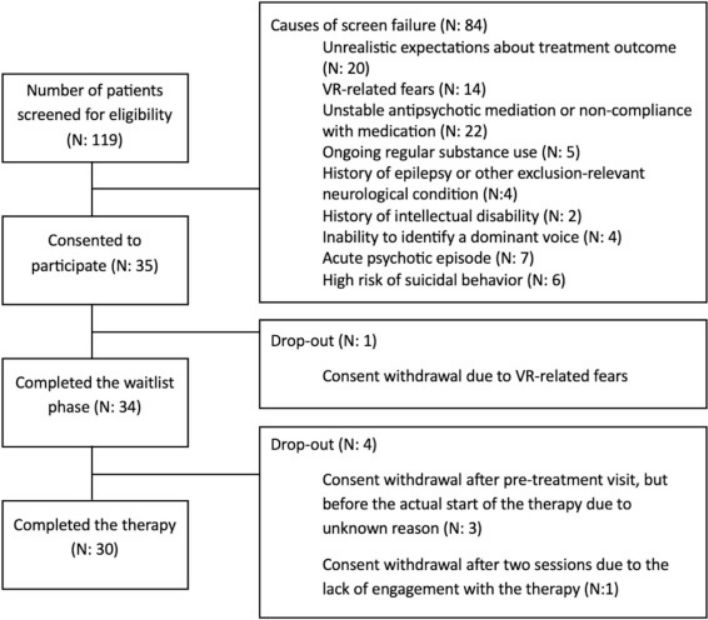
Between January 2024 and June 2025, researchers assessed 119 people. As many as 84 did not meet the eligibility criteria. The most common reasons for exclusion were unstable or inconsistent use of antipsychotic medication, unwillingness to continue medication alongside psychotherapy, and fear of virtual reality. Thirty-five people agreed to participate, but five withdrew before completing the waiting period or starting therapy. The final sample consisted of 30 patients, with an average age of 37.7 years. Most had been living with the illness for more than five years, and the average duration of illness was nearly 14 years.
The therapy was delivered by psychiatrists and clinical psychologists with specialist qualifications in psychotherapy and more than ten years of experience. Before beginning the intervention, they completed training organised by the developers of the therapy manual. Throughout the study, they also attended supervision sessions every two weeks.
During the sessions, patients wore Oculus Rift VR headsets and noise-cancelling headphones, allowing them to become fully immersed in the virtual environment. The software was developed by Challenge Aps and provided by HEKA VR. The therapy consisted of seven individual sessions over 12 weeks, while patients continued their regular antipsychotic medication.
Importantly, avatar therapy is not intended to replace established treatments for schizophrenia or antipsychotic medication. Instead, it is designed as an additional therapeutic approach that may help patients manage auditory hallucinations, reduce the distress associated with them and develop a greater sense of control. It should therefore be understood as a complement to existing care, rather than an alternative to it.
The results are encouraging. Thirteen of the 30 participants, or 43.3 per cent, experienced clinically meaningful improvements in their symptoms. For four people, the severity of auditory hallucinations decreased by at least half, while two reported that they no longer heard the voices at all after therapy. On average, participants heard the voices less frequently and felt less distressed by them. However, not everyone benefited: seven participants experienced a worsening of their scores, while no change was recorded in three.
“Most participants found the therapy helpful and valuable, with comments such as “I think it is very useful, as many people with schizophrenia as possible should try it.” or “I think it’s a cool thing. A person can get to know another world within themselves.”… “It helped me a lot, specifically in understanding the voice”…. “Before, I always just ignored the voice. Now, for the first time, I talked to it – that meant a lot”). .. “The chosen voice was so characteristic to my voice. It was realistic. The mimics were realistic too.”, while others simply stated, “It was realistic.”)… “It helped with my current condition. But I don’t know why the voices disappeared. Medication might have had a role in it as well. Actually, I don’t think they disappeared. They’re still in the background.” Egervári et al.
The study has important limitations. It involved a small number of participants, was not randomised, and did not include an active control treatment against which the results could be directly compared. The researchers also did not investigate how long the improvements lasted after treatment ended. The findings suggest that virtual reality could become a useful addition to existing treatments. Avatar therapy does not guarantee that the voices will disappear. Its potential may lie precisely in helping people who hear voices become less afraid of them and regain a sense that they, rather than the voices, are in control of their own lives.
Photo: Bálint Barta – Semmelweis University
