

Nationwide study reveals regional disparities in access to oral and maxillofacial surgical care in Japan
Universal health insurance provides broad financial access to healthcare, but geographic differences in healthcare resources can still influence the availability of specialist care. A recently published analysis of oral and maxillofacial surgery in Japan points to significant regional disparities.
The study “Healthcare access to oral and maxillofacial surgery in Japan: Distribution of dental clinics, hospitals, and dentists certified by the Japanese Society of Oral and Maxillofacial Surgeons,” by Hikaru Fukuda, Masaki Morishita, Osamu Takahashi, Michi Fujita, Norihiko Furuta, and Manabu Habu, analyzed access to oral and maxillofacial surgery in Japan by examining the distribution of dental clinics, hospitals, and dentists certified by the Japanese Society of Oral and Maxillofacial Surgeons (JSOMS).
“Unlike gatekeeper-based systems adopted in some countries, patients in Japan can directly access secondary and tertiary care institutions without referral restrictions. Therefore, the geographic distribution of healthcare resources may have a direct impact on healthcare accessibility and utilization.”Fukuda et al.
The study covers all 47 Japanese prefectures and provides insight into how resources are organised in one of the most demanding fields of dental medicine. Oral and maxillofacial surgery includes a wide range of procedures, from routine interventions to complex tumour operations and emergency treatments, and requires highly trained specialists as well as appropriate infrastructure. The data used in the analysis were drawn from official sources. Information on hospitals and dental clinics comes from national databases of the Ministry of Health, Labour and Welfare. At the same time, data on certified and specialist surgeons were obtained from records of the Japanese Society of Oral and Maxillofacial Surgery. To allow comparison across regions, all indicators were standardised by population size, typically per 100,000 people.
“By integrating workforce and facility data and standardizing them by population, this study represents the first nationwide assessment of regional disparities in oral and maxillofacial surgery from both the human and structural perspectives, thus providing new insights into the regional distribution of oral and maxillofacial surgery-related healthcare resources and potential accessibility.” Fukuda et al.
The
The results
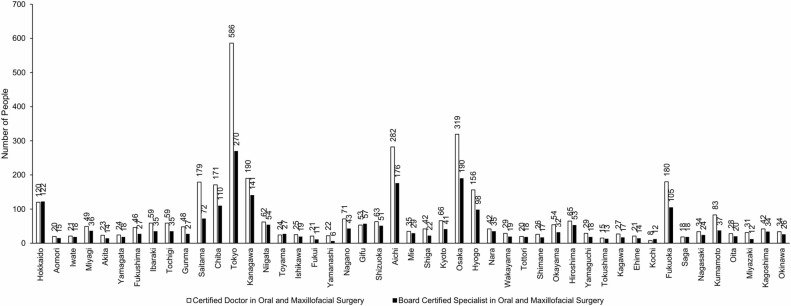
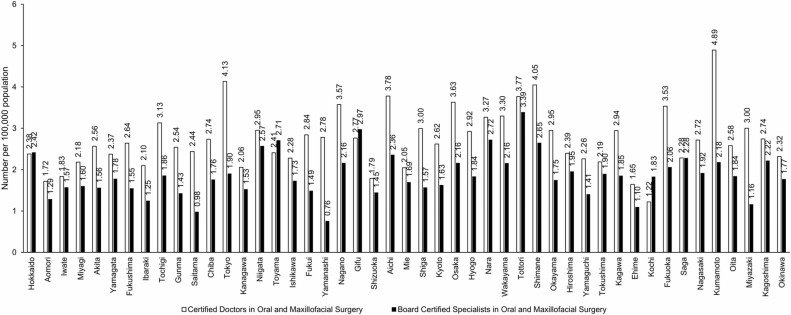
The results show that several thousand certified oral surgeons are practising in Japan, a substantial proportion of whom are specialists. However, their distribution is uneven. The highest concentration of experts is found in major urban centres such as Tokyo and Osaka, as well as in other large prefectures. These areas have a higher concentration of specialised healthcare resources, which may facilitate access to care. The situation is different in less populated, rural regions. In some prefectures, the number of specialists relative to the population is significantly lower than in urban areas. This can mean longer waiting times, the need to travel to other regions, and a more limited range of available services. It is important to note that per capita figures can sometimes give the impression of adequate coverage in sparsely populated areas, even when actual access to services remains limited.
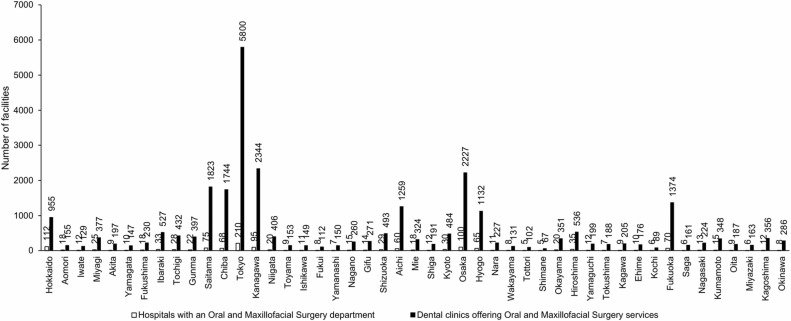
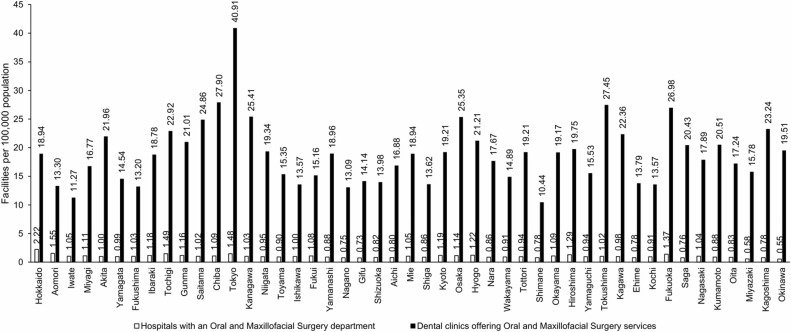
Similar patterns can be observed in the distribution of healthcare facilities. The analysis shows that a large number of hospitals and dental clinics in Japan provide oral surgery services, with urban regions having the highest absolute numbers. To better understand the structure of the system, the researchers applied a statistical clustering method (K-means), identifying several distinct regional models of healthcare organisation. Some prefectures are characterised by a high concentration of dental clinics, while others have a relatively greater share of hospital-based care. There are also regions with a more balanced distribution of resources, as well as those that rely more heavily on outpatient services.
It is important to emphasise that the analysis assesses potential access to care based on the number of specialists and facilities, but does not include data on the actual volume of procedures or the quality of care provided. Nevertheless, it offers an important basis for understanding spatial inequalities within the system.
Japan is not an exception in this regard
Differences between urban and rural areas in access to specialised healthcare are present in many countries. The concentration of educational and clinical centres in large cities often attracts specialists, while less developed regions struggle to maintain the same level of access. This analysis shows that even in a system aiming for universal coverage, geographical factors continue to play an important role. “These findings suggest that in future regional healthcare policy planning, the allocation of human resources and the development of healthcare facilities for oral and maxillofacial surgery are crucial for addressing regional disparities….Future research should incorporate multidimensional indicators, including case volume, type of clinical procedure, treatment outcomes, and patient satisfaction, to enable a more comprehensive evaluation of oral and maxillofacial surgical care at the regional level,” the authors concluded in the study.
Image: School of Dentistry
