

How a Scientific Approach Helped Ease Workers’ Fears: A Rare Liver Cancer Case in the PVC Industry
When a rare and aggressive form of liver cancer, angiosarcoma, appeared in a Swedish polyvinyl chloride (PVC) factory nearly three decades after the last recorded case, fear spread among the workers. But what followed was a scientific intervention that not only clarified the real risks but also successfully calmed concerned employees.
“In 2004, a total of 227 cases of liver angiosarcoma were recorded within the PVC production industry from 17 different countries worldwide. Five cases of liver angiosarcoma, diagnosed between 1970 and 1980, have been reported from Sweden. The Swedish cases had their first exposure to vinyl chloride between 1945 and 1964 (median 1947), with latency periods of 16-31 years (median 27 years). No diagnosed cases of angiosarcoma among workers employed after the mid-1970s had before this intervention been discovered within the Swedish industry since the 1980s due to strict occupational exposure limits and drastic changes in work practices after the mid-1970s. Therefore, the discovery of a sixth case in Sweden, almost 30 years after the last known case, had a strong negative effect on the workers, and many expressed great concerns and worry over this diagnosed case of liver angiosarcoma.” Andersson & Åkerström (2026)
Liver angiosarcoma is a rare cancer known for its link to exposure to vinyl chloride, a key raw material in PVC production. Although strict safety regulations and improved workplace practices have drastically reduced exposure since the mid-1970s, the emergence of a new case in a worker who had been exposed as far back as 1951 reopened questions about workplace safety.
A team of experts from Sahlgrenska University Hospital in Gothenburg developed a methodological approach to address the crisis. “Occupational cancer remains an ongoing and emerging issue in cancer prevention and control, and is more easily preventable in practice than other causes. Several rare cancers are well known to be caused by occupational factors, but the contribution of occupational exposures to rare cancers remains insufficiently considered due to a lack of evidence and/or awareness by clinicians. This lack of knowledge has also been shown to result in unmet supportive care needs of patients with rare cancer, especially support in relation to their workplace,” they explained in the study.
The authors are Eva Andersson and Magnus Åkerström, and their article titled “Methodological approach for assessing risks and reducing workers’ worry for rare occupational cancer—managing a case of liver angiosarcoma” was published at the end of June 2026.
Their method, detailed in a recent paper published in ESMO Rare Cancers, consisted of five key steps:
- Thorough case investigation: Confirming the diagnosis and collecting detailed information about the affected worker’s exposure history.
- Retrospective exposure assessment: Analysing historical data and interviewing workers to estimate vinyl chloride exposure across different periods, especially before modern safety standards were introduced.
- Risk communication: Open and transparent communication with both employers and employees, through individual discussions and group meetings, to explain the findings and ease concerns.
- Evaluation of the intervention: Monitoring how communication affected workers’ level of concern.
- Knowledge transfer: Sharing the lessons learned with other industries and healthcare institutions.
“This methodological approach was successful in reducing workers’ worry about a rare occupational cancer and could also be successfully applied to other rare occupational cancers. Results showed a negligible risk of angiosarcoma due to vinyl chloride exposure among Swedish workers employed after 1974. Even current workers employed before 1974 had a limited risk.” Andersson & Åkerström (2026)
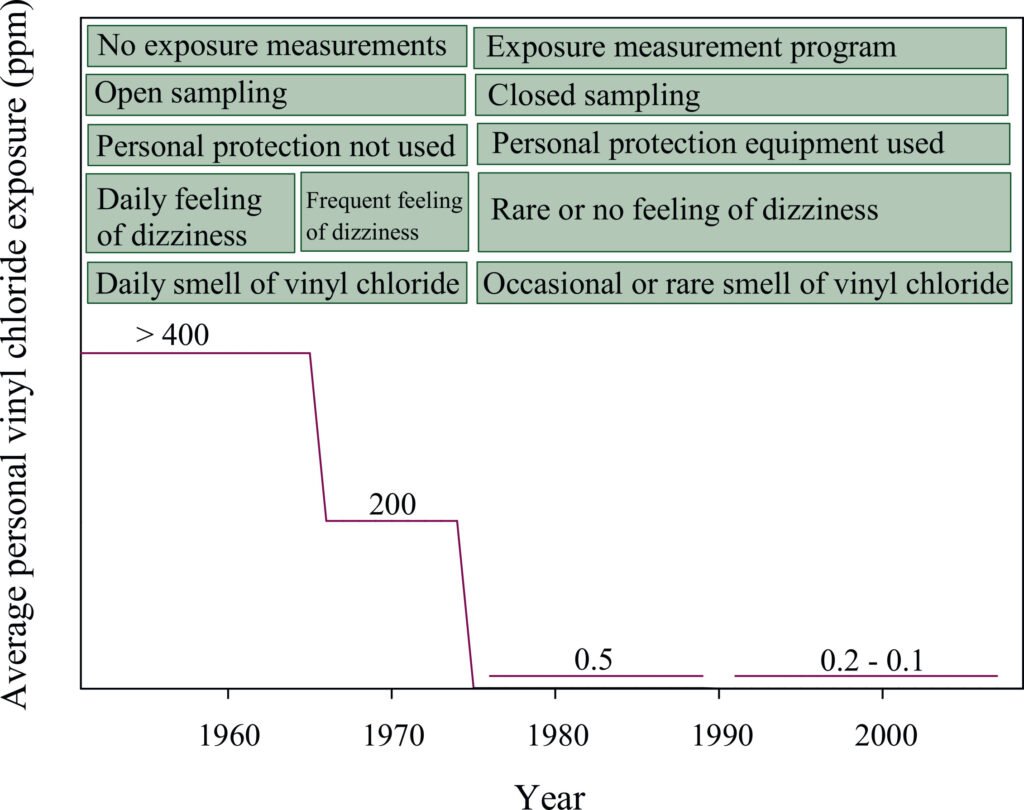
“The retrospective exposure assessment was based on historical results from work environment measurements of vinyl chloride. However, the company had no exposure-monitoring program for vinyl chloride before 1974, and only a few isolated measurements could be found. Thus, the retrospective exposure assessment before 1974 was performed using information from occupational hygienists and experienced personnel at the company, published literature, and from an interview with the index case, who had worked within the industry since 1951.” Andersson & Åkerström (2026)
The importance of proactive occupational risk management and transparent communication
The most important part of the study was the detailed risk assessment. For the worker diagnosed with angiosarcoma, the estimated cumulative exposure to vinyl chloride was 6,400 ppm-years, resulting in a calculated lifetime risk of about 20%. This clearly reflected the dangers workers faced in earlier decades. However, for workers employed after 1974, when major changes in production processes and safety measures were introduced, the situation was very different. The study showed that their lifetime risk of angiosarcoma was below 0.03%. Even for a small number of employees who had started working before 1974 but continued afterward, individual risk estimates ranged from 0.03% to 1%.
These findings played a key role in reassuring workers. The study is a reminder of the importance of proactive occupational risk management and transparent communication. In situations where workers’ health is called into question, a science-based approach combined with clear communication can be one of the most effective ways to reduce fear and maintain trust in the workplace. “An intervention combining an investigation on the risks and conditions at the workplace, combined with risk assessment and risk communication to the staff, was able to reduce worry for occupational angiosarcoma among the current workers caused by a newly diagnosed case at the factory. This strategy could also successfully be applied to other situations and exposures,” the authors concluded.
Image: Rare Cancers | NFCR Blog
