

An urgent call to stem decline of nature
“Our planet is losing biodiversity at an unprecedented scale, with devastating consequences for people. Yet, global efforts to stem biodiversity loss and the decline of nature have failed repeatedly. Instead, increasing levels of overconsumption and waste, coupled with the direct drivers of land-use and sea-use change, direct exploitation of organisms, climate change, pollution, and invasive alien species have accelerated biodiversity loss during the past 50 years.”
With these words, an international team of authors began an opinion piece published in September, entitled “Transformative change to address biodiversity loss is urgent and possible.” The authors are Anne Larigauderie, Karen O’Brien, Lucas A. Garibaldi, and Arun Agrawal.
We spoke with Dr. Anne Larigauderie, former Executive Secretary of the Intergovernmental Platform on Biodiversity and Ecosystem Services (IPBES), and an independent science and policy advisor.
She received several awards, including “Chevalier de l’Ordre national de la Légion d’Honneur”, Officier dans l’Ordre national de la Légion d’Honneur, and Commandeur dans l’Ordre National du Mérite, from the government of France. Under her leadership, IPBES received prestigious Prizes, including the Biodiversity Award of the Prince Albert II of Monaco Foundation (2021), the Gulbenkian Prize for Humanity shared with IPCC (2022), and the Blue Planet Prize (2024).
She replied on behalf of all the co-authors of the paper.
Relying on the IPBES Transformative Change Assessment Report, they explain not only why past efforts to address biodiversity loss have been ineffective, but also point to five key strategies for achieving the 2050 Biodiversity Vision and how we can all help.
About the Report
“As humanity faces the consequences of unsustainable practices, it is clear that transformative change is not just an option—it is a necessity. The Thematic Assessment of the Underlying Causes of Biodiversity Loss and the Determinants of Transformative Change and Options for Achieving the 2050 Vision for Biodiversity (Transformative Change Assessment) highlights that to achieve this transformation, we must redefine the relationship between people and nature, basing new visions on inclusive, just, diverse, and forward-thinking approaches that address the underlying causes of biodiversity loss.” (IPBES, 2024, Foreword).
Over three years of work by nearly 100 international scientists and holders of Indigenous and local knowledge resulted in a 400-page report. They critically assessed approximately 7,000 publications and analyzed more than 400 studies. In December of last year, the report was approved by the 11th plenary session of IPBES. It aims to inform the implementation of the Global Biodiversity Framework.
“Transformative change for nature and biodiversity involves significant government action. However, many States have been slow to implement such changes. Corruption is one factor impacting how environmental protection policies are enforced, resulting in weakening environmental policy enforcement and in blocking efforts to achieve transformative change.” (IPBES, 2024)

“While there is a large body of literature assessing the impacts of human activities on biodiversity within a social-ecological systems framework, there is much less information on how human lives and livelihoods are affected positively or negatively by actions toward transformative change.” (IPBES, 2024)
This report is significant because it identifies the deep, systemic causes of biodiversity loss that past policies have failed to address, and it presents options for achieving the 2050 Biodiversity Vision. It is structured in two key parts: a Summary for Policymakers and five detailed analytical chapters (Transformative change and a sustainable world; Visions of a sustainable world – for nature and people; How transformative change occurs; Overcoming the challenges of achieving transformative change towards a sustainable world; and Realizing a sustainable world for nature and people: transformative strategies, actions, and roles for all).
Transformative change to address biodiversity loss is urgent and possible
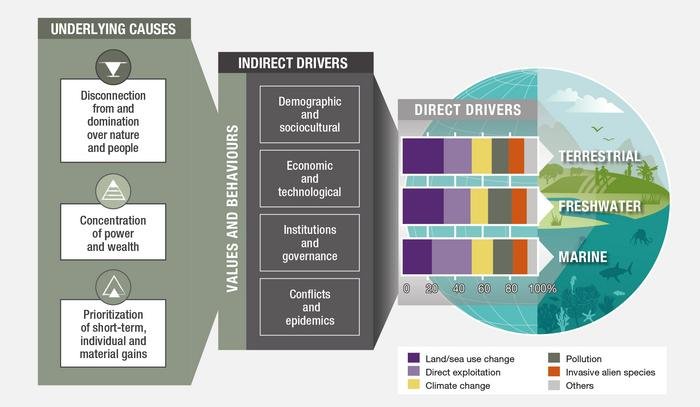
As the authors explain in the article, previous attempts to stem biodiversity loss and nature’s decline have failed because the underlying causes have not been resolved. At issue are separation from nature and people and domination over them, the increasing concentration of power and wealth, which supports the interests of a small number of people whose actions disproportionately encourage the loss of biodiversity and the deterioration of nature, and, thirdly, the prioritization of short-term, individual, and material gains. These are factors that increase inequalities.
“Principles of transformative change, such as equity and justice, pluralism and inclusion, respectful and reciprocal human–nature relationships, and adaptive learning and action, are important for addressing these challenges. Such principles can be applied to five key strategies and actions to advance transformative change towards a just and sustainable world,” they wrote.
The first strategy relates to transformative change, emphasizing the preservation, restoration, and regeneration of places of cultural and ecological significance, especially when Indigenous and local governance systems are respected and strengthened. The second strategy is aimed at integrating biodiversity issues into the sectors most responsible for environmental degradation. These sectors include agriculture, fisheries, forestry, infrastructure, and energy.
The third strategy calls for the transformation of economic and financial systems for nature and justice, i.e., the internalization of environmental costs, the reform of fiscal tools, and the change of success metrics to take into account ecological integrity and social justice. The fourth strategy emphasizes management reforms, where institutional arrangements that encourage joint planning, mutual responsibility, and respect for different knowledge systems are important.
Fifth, and crucially, they state the need to change social attitudes and values. This is where it is very important to recognize the interconnectedness of people and nature through education, communication, and social movements that can reshape norms and behaviors. Curricula and programs that integrate systemic thinking, appreciation of nature, and empathy are important in this, and help in the education of new generations.
“Transformative change is urgently needed. Without it, repeated failures to reach global sustainability and biodiversity goals will continue to occur because they do not attend to the underlying causes of biodiversity loss and trajectories of unsustainable change,” the authors warn.
Positive outcomes for both nature and people can be achieved within less than a decade
What is the key action for countries to take, considering the overall situation in the world?
Dr. Anne Larigauderie: The article in PLOS Biology emphasizes, based on the IPBES Transformative Change Assessment, that every person, group, and organization has a role in pursuing the actions needed to create transformative change and to implement the five strategies highlighted in the paper. The question focuses on the role of governments. Governments are powerful actors and, as such, have a major role to play in enabling transformative change. They can foster policy coherence, enact and enforce stronger regulations to benefit nature and nature’s contributions to people in policies and plans across different sectors, deploy innovative economic and fiscal tools, phase out harmful subsidies, and promote international cooperation.
An example of a key action for countries to take would be to phase out and eliminate subsidies that are harmful to biodiversity. This is, in fact, one of the 23 targets of the Global Biodiversity Framework approved by the Parties to the Convention on Biological Diversity in 2022. Global public explicit subsidies to sectors driving the decline of nature ranged between $1.4 and $3.3 trillion in 2022, with agriculture (through support for pesticides and overuse of fertilizers, among others) and fossil fuels being the two sectors receiving the most subsidies. This is between 10 and 20 times more than the $135–156 billion per year spent on biodiversity conservation.
Redirecting direct subsidies and shifting indirect subsidies towards sectors that support the conservation, restoration, and sustainable use of biodiversity will close the biodiversity financial gap and support efforts by developing countries to conserve their biodiversity, which generates employment.
What is the most difficult part of these strategies, and where should we start?
Dr. Anne Larigauderie: The most difficult part of implementing these strategies is addressing the three underlying causes of biodiversity loss, which are systemic, persistent, and pervasive: a) the disconnection of people from nature and the domination of people over nature; b) the concentration of power and wealth; and c) the over-prioritization of short-term, individual, and material gains. Together, they undermine the effectiveness of efforts to conserve and sustainably use biodiversity and contribute to challenges and barriers to transformative change.
These can be addressed by following the principles for transformative change in efforts to shift views—ways of thinking, knowing, and seeing; structures—ways of organizing, regulating, and governing; and practices—ways of doing, behaving, and relating. It is possible to promote and accelerate transformative change by selecting and advancing strategies and actions for the conservation, restoration, and sustainable use of biodiversity and nature that integrate across views, structures, and practices to specifically address underlying causes.
How quickly can the benefits of these strategies be felt?
Dr. Anne Larigauderie: Direct benefits from pursuing the strategies that stop biodiversity loss and restore nature will be felt within a few years—especially in terms of increased employment and incomes, reduction of pollution, improvements in health, and greater quality of well-being—although there will be variations across places. People and communities, similarly, can achieve transformative change in local social-ecological systems and socioeconomic conditions very rapidly as well.
Achieving transformative change at macro scales requires alignment in direction and effort across many specific cases and examples of transformative change and will depend on the types of action undertaken, levels of investment, and the scale of attempted changes.
Positive outcomes for both nature and people can be achieved within less than a decade. For example, since 2016, the Nashulai Maasai Conservancy in Kenya has experienced a remarkable return of wildlife. This indigenous-owned and -run conservancy covers a critical migratory corridor for wildlife and promotes a mixed-use commons where people and wildlife can thrive together.
The World Wildlife Fund (WWF) Living Planet Report, published in 2024, warns that in just 50 years, from 1970 to 2020, there has been “a catastrophic 73% decline in the average size of monitored wildlife populations.” The largest declines have been in freshwater populations (85%), followed by terrestrial (69%) and marine (56%). Habitat loss and degradation, as well as overexploitation, are the dominant threats to wildlife populations worldwide. According to the data, between 1990 and 2020, an estimated 420 million hectares of forest (mostly tropical) were lost, and an additional 10 million hectares are being lost every year. When we factor in invasive species, climate change, and wildfires, it is clear that the future may not be as biodiverse.
Image: Underlying causes, indirect drivers, and direct drivers of biodiversity loss and nature’s decline, Larigauderie A, et al., 2025, PLOS Biology, CC-BY 4.0 (https://creativecommons.org/licenses/by/4.0/)
The authors received no specific funding for this work.
