


Chile’s New Leader Praises Pinochet; New Book Unmasks Regime’s Cruelty
A new book by Dr. Katia Chornik, Music and Political Imprisonment in Pinochet’s Chile, was published this month by Oxford University Press. The book is based on a decade of research into the experiences of political prisoners under Pinochet’s dictatorship, exploring the use of music as both a tool of torture and a means of resistance. We spoke with Dr. Chornik about her book and about how young people today, growing up in a society where some still admire dictators, can gain a broader and deeper understanding of this history.
110 years ago, Augusto Pinochet Ugarte was born, a name that still evokes strong emotions in Chilean history and, consequently, deep divisions. Born on November 25, 1915, in Valparaíso, Pinochet built a military career that, in the context of political instability, led him to the head of the state following the military coup on September 11, 1973. With this act, the democratically elected government of President Salvador Allende was overthrown, and a period of military dictatorship began, lasting until 1990. During the seventeen years of his rule, according to records, more than 3,000 people were killed or disappeared, while around 40,000 people were politically imprisoned and tortured. Despite the efforts of the state and human rights organizations, numerous records of the disappeared are still missing.
Torture under Pinochet’s dictatorship
Torture under Pinochet’s dictatorship was carried out not only physically but also psychologically, and one of the methods was the systematic use of music. In detention centers such as Villa Grimaldi or Venda Sexy, prisoners were forced to listen to songs during torture. One of the most well-known examples was the song “Gigi l’amoroso”, which agents played while carrying out torture, and the word “Gigi” in prison slang referred to the device used to administer electric shocks. Nevertheless, many prisoners, despite the cruelty of the situation, used music as a means of inner resistance, singing among themselves to maintain hope.
The book: Music and Political Imprisonment in Pinochet’s Chile
Within this historical and moral framework, the book Music and Political Imprisonment in Pinochet’s Chile was published by Oxford University Press. The author, Dr. Katia Chornik, a research associate at the Centre for Latin American Studies at the University of Cambridge, approaches this subject with both academic precision and personal responsibility. Her parents were imprisoned during Pinochet’s dictatorship, which further deepens her understanding of the complex human experiences within a system of repression.
“You lived a permanent torture session because if they weren’t torturing you, you were listening to the torture of others, which was absolutely unbearable. And with music the whole time.” Ana María Jiménez, a music teacher and pianist. She was arrested and taken to the torture and detention complex of Villa Grimaldi in Santiago.
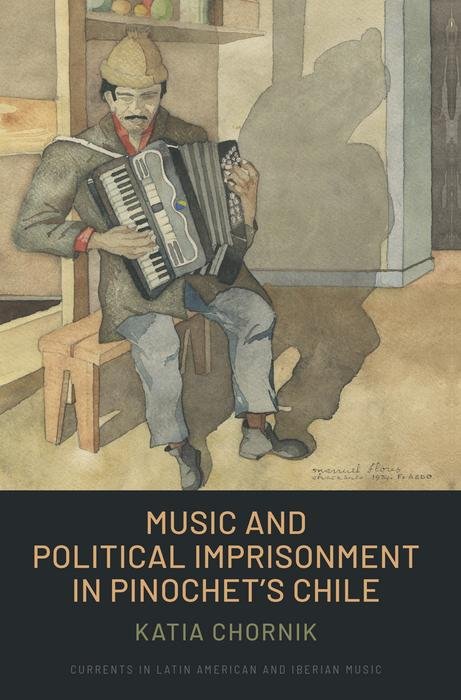
The book is structured to guide the reader through a clearly organized whole: it begins with the Prologue by Michelle Bachelet Jeria, and then develops through the chapters Music Threaded into Torture and Other Mistreatment, The Memories and Songs of a Convicted Perpetrator, Beyond Canonic Narratives of Resistance, Grassroots Commemoration and Revival, and concludes with Archiving Memories: The Cantos Cautivos Digital Project. The author notes she felt it was a matter of ‘now or never,’ as many survivors had already passed away. Dr. Chornik interviewed dozens of survivors, as well as former prison guards and convicted perpetrators from the Pinochet regime.
“I’m currently working with UNESCO on a project that will help young people get the bigger picture about the dictatorship.”
After more than 100 years, there is still praise and admiration for dictators or for politicians who have brought nothing good. In that sense, there is also an influence on young people. Which part of the book would you say can help young people get the bigger picture?
Katia Chornik: Yes, indeed. There is still praise and admiration for Pinochet. Think of José Antonio Kast, a long-time admirer of Pinochet, who has just won the presidential election with 58% of the votes last week. This shows that current generations have forgotten or do not know enough about the crimes committed during the dictatorship. Already in 2023, a survey found that a third of respondents had a positive opinion of the dictatorship and 20% viewed Pinochet as one of the best rulers of Chile. Regarding young people reading my book, it depends on how young! My book would probably not be appropriate for school-age children.
I’m currently working with UNESCO on a project that will help young people get the bigger picture about the dictatorship. The project is an educational booklet with guidance and classroom resources for human rights education based on Cantos Cautivos. Its target audience is secondary school teachers in Latin America and the Caribbean, but it can also be useful for teachers in other countries, especially in teaching related to the Cold War and experiences of repression in other geographical and historical contexts. The booklet is expected to be available by mid-2026, and it will include lesson plans in different subjects.
“I endured fear, stress, disgust…I will not put myself through this experience again.”
I understand that this is a very difficult story. First of all, you had a lot of courage to share it. As the author of this book, how did you manage to balance all your emotions by the end of the book?
Katia Chornik: I have strived to remain as open-minded as possible and minimise biases towards people with whom I do not share views or affinity, while condemning all forms of violence from across the political spectrum. Drawing on personal experience as a child of people who went through the experience of political imprisonment, I navigated emotional challenges by setting boundaries, learning what could be asked and not asked, recognising the risks of sensationalising suffering, all while striving for ethical responsibility and looking after myself as stories about experiences of imprisonment and torture are difficult to narrate but also difficult to listen to. Interviewing former agents of the secret police services was especially hard: I endured fear, stress, disgust, and unwelcome comments, and some of those emotions were also felt by the colleagues who supported me with this work. I will not put myself through this experience again.
Research, ethical commitment, and profound empathy
As emphasized by Michelle Bachelet Jeria, former President of Chile, this work documents historical facts and invites deep reflection on the transformative power of music and memory. Her meticulous research, ethical commitment, and profound empathy ensure that the voices of those who were silenced are preserved and honored. The book Music and Political Imprisonment in Pinochet’s Chile is now available from Oxford University Press for $35.
Image: Third-floor interior of Valparaíso Jail in 2000, where political prisoners were detained under Pinochet’s regime. Photo by Mario Patricio Cordero.
