

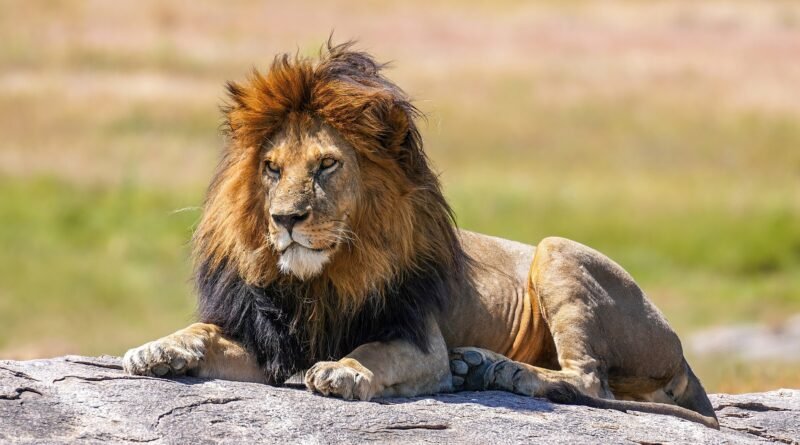
For Lions, Slowing Down at the Right Moment Is Key
A lion charging toward its prey may look like the embodiment of raw power and speed. But a new study shows that success in the final stage of a hunt does not depend solely on how fast it can run. Equally important is how precisely it can control its own movement.
This fascinating study, conducted by researchers Isla Duporge and Hadleigh Frost, takes a closer look at how lions control their movements during the final stage of a hunt. Their findings are detailed in the study “Quantifying the Control Laws Governing Terminal Attack in Lions.”
Researchers recorded 67 attacks by six lions using drones in a 1.3-hectare enclosed area in the United States. The lions chased a mechanized lure that moved along different routes and at different speeds. The scientists then used an artificial intelligence system to reconstruct the positions of the lions and the lure at every moment of the chase. This approach made it possible to precisely measure how a lion changes direction and speed from moment to moment. The study focused on the phase of the chase in which the lion approaches its prey. If a lion traveling at high speed has to suddenly change direction, its ability to turn is limited.
The faster a lion moves, the more difficult it is for it to make a tight turn
The results show that lions do not try to run at maximum speed all the time. Their speed decreases as the need to turn increases. In other words, a lion does not simply choose its speed, but adjusts it to the demands of the maneuver. For a given capacity to generate lateral acceleration, the turning radius increases with the square of speed. The faster a lion moves, the more difficult it is for it to make a tight turn.
Because of this, greater speed is not always an advantage. If prey suddenly changes direction, a lion moving too fast must choose between making a wider turn and reducing its speed. In this context, the study highlights the difference between predator and prey capabilities: lions have a greater advantage in acceleration and deceleration, while their advantage in lateral maneuverability is considerably smaller. Zebras and impalas, for example, have a higher step frequency, which allows them to generate lateral acceleration more frequently.
Two basic modes of control
The researchers described the lions’ behavior using mathematical models that are used to study guidance and pursuit systems. Among other things, they tested two basic modes of control. In proportional pursuit (PP), the attacker’s direction of movement depends on the angular position of the prey relative to it. In proportional navigation (PN), the rate of change of that angle plays an important role, that is, the way the geometry between the predator and prey changes.
The model that best described the data combined both strategies — proportional pursuit and proportional navigation (PP+PN). This model had the smallest error in reconstructing the trajectories. The combination means that a lion’s directional control depends not only on where the prey is at a given moment, but also on how the geometry of its movement relative to the lion is changing. This does not mean that the study directly demonstrated that a lion mentally “predicts” the future trajectory of its prey; rather, it is a mathematical description of its behavior based on the prey’s position and movement.
This result should be interpreted cautiously
Interestingly, speed itself was not the only element of control. The authors conclude that directional control and speed regulation must be viewed as interconnected processes. The lion adjusts its speed so that it maintains the capacity needed for lateral maneuvering while simultaneously responding to the position of the prey.
The study also found indications that lions reduce their speed further when they are at very short distances from the lure, which could be related to avoiding overshooting the target. However, this result should be interpreted cautiously. Models that included the distance from the prey produced only small improvements, none of which were statistically significant. The authors also warn that the result may have been related to the experimental design, because the chase route ended at the enclosure fence. This is one of the important limitations of the study. The experiments were not conducted during natural hunts involving free-ranging prey, but under controlled conditions using a mechanized lure. Therefore, the results cannot simply be applied to every situation in which a wild lion hunts real prey.
Nevertheless, the research shows how drones and artificial intelligence can open a new window into animal behavior. Hunting can be analyzed as a precise system of interconnected decisions and physical constraints, in which speed, distance, changes in direction, and turning ability together determine the predator’s movement.
For a lion, therefore, the fastest route to its prey is not necessarily the best one; at certain moments, the ability to slow down may be the very thing that provides the advantage.
