

Why Climate Warnings Don’t Feel Real Until Disaster Hits?
Climate disasters such as wildfires and floods are becoming more frequent and more intense, which also creates additional challenges, especially when it comes to encouraging people to actually prepare for them. The study “Enhancing climate resilience with proximal cues in personalized climate disaster preparedness messaging,” suggests that when risk messages feel personal and local, people are much more likely to pay attention and take action.
In other words, it is a matter of psychological distance that makes taking action more difficult. Whether it is temporal distance (the consequences are in the distant future), spatial distance (it is happening somewhere else), or social distance (it affects other people), the impact is clear. Campaigns to raise awareness about climate risks often rely on general information and statistics, which, although accurate, sometimes fail to bridge this psychological distance.
Researchers Nurit Nobel and Michael Hiscox conducted a large field experiment with homeowners in Australia living in areas vulnerable to wildfires. To explore the findings further, we spoke with Nurit Nobel, lead author and researcher at the Center for Sustainability Research at the Stockholm School of Economics Institute for Research.
Does this even affect me? – Experiment in Australia
“To test the effect of including proximal cues in climate risk communication on willingness to safeguard properties, we conducted a field experiment with a total of 12,985 customers of a large Australian retail bank,” they explained in the study. Participants were aged 19 to 96, and emails were sent to participating bank customers from 12 December 2023, ahead of the Australian summer season.
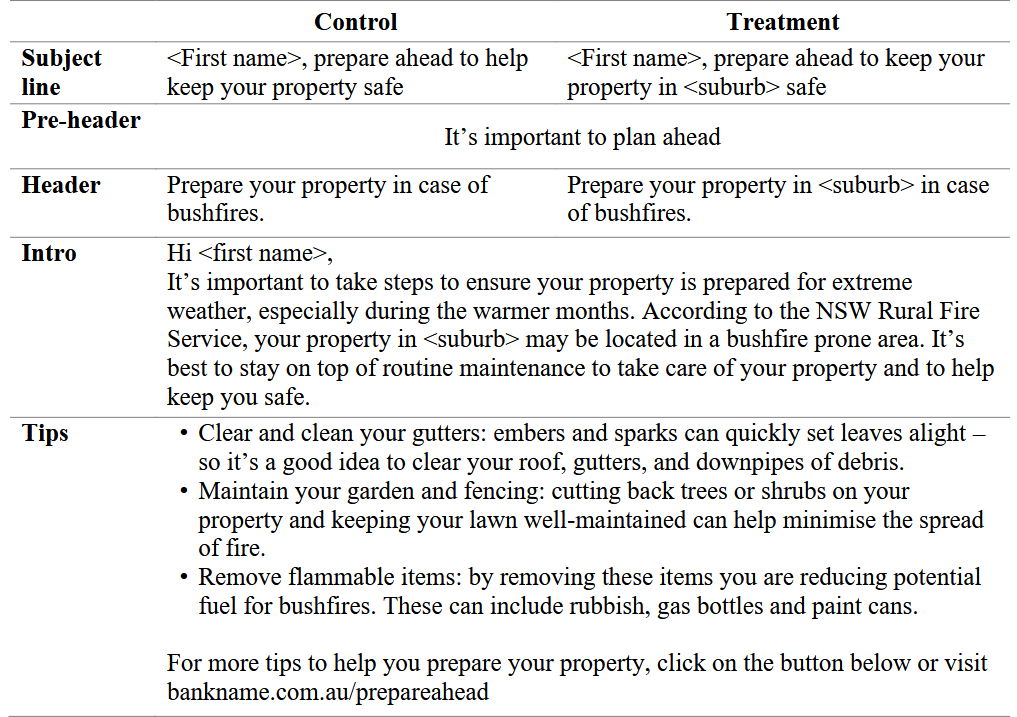
Half of the participants received generic emails about fire preparedness, while the other half received personalized emails that included the name of their suburb. Engagement was measured in three ways: email opens, clicks on a link for more information, and visits to a landing page. While email open rates were small, the results for clicks and visits were much more convincing.
Results that inspire action
The study showed that participants who received localized messages were twice as likely to seek additional information about fire preparedness compared to those who received generic messages. These findings have important implications for climate change communication and disaster preparedness strategies. Personalized messages that directly connect climate risks to an individual’s immediate environment motivate people to protect what is close to them.
What changes would you like your study to inspire?
Nurit Nobel: I would like us to talk more about climate adaptation and how homeowners can protect themselves from extreme-weather events. Regardless of where we stand on climate politics, climate change is already shaping our environment and bringing with it more weather-related disasters like wildfires and floods. Well, we can’t change the weather, but it turns out that there are steps homeowners in risk areas can take to reduce their risk of exposure. And mitigating the damage is in the interest of all of us – governments, banks, insurance companies, and of course, individual homeowners. I hope this study brings more awareness to this issue.
“Our study shows that the way this information is communicated—especially when it feels local and personal—makes a real difference in whether people engage with it.” What is key in this process, or how can awareness of potential dangers be increased?
Nurit Nobel: Climate risk feels far away. It feels like something that may or may not happen, to someone else, far away from me, someday. Not to me tomorrow. Because of this, people tend to downplay the risks and are less inclined to take action. So the problem is not that people are not aware of the risks, but more that the risks feel diffused and irrelevant to me. Our study finds that by activating individuals’ sense of place, we manage to make the risk feel local and relevant, which then urges them to take action to protect themselves.
The study highlights that behavioral science should play a key role in addressing climate challenges. “These results provide evidence that tailoring messages to reduce psychological distance and foster place attachment can encourage climate resilience…” is stated in the study. The authors emphasize that the results offer practical insights for practitioners designing effective communication strategies to promote climate change resilience and empowerment. They suggest that banks, insurers, and local authorities can incorporate proximal cues into their information campaigns to ensure that messages resonate with individuals and inspire concrete actions that reduce vulnerabilities.
When asked whose support matters most in this context, Nurit Nobel concluded, “When it comes to climate risks, we all have a role to play, and it is important that this continues to be a multi-stakeholder effort: policymakers, banks, insurance companies, and individual homeowners are all affected by climate-related disasters and should all be a part of the solution. As a researcher, it was great to collaborate with a large retail bank in conducting this study, and I hope that we continue to have such collaborations in the future. To solve big problems, we need everybody’s help.“
Image: PhD Nurit Nobel
