

First Known Case of a Rare Fungus Causing Nail Infection Reported in Colombia
A common fungal infection of the nails, known as onychomycosis, is relatively frequent and is most often associated with dermatophytes. However, the case of a 46-year-old woman from Colombia showed that an apparently typical infection can sometimes be caused by a much more unusual organism.
The authors of the report entitled “First case report of onychomycosis caused by Exophiala alcalophila” are Lili Rueda-Jaime, Leticia Sopó-Prada, and Carolina Firacative.
The woman, with no significant underlying medical conditions, had experienced changes in both big toenails for approximately 20 years. Several years before her examination, she had undergone repeated procedures for ingrown toenails. The discoloration persisted after these interventions.
“Exophiala is a genus of dematiaceous fungi ubiquitously present in the environment, currently comprising more than 60 species, with Exophiala dermatitidis, Exophiala jeanselmei, and Exophiala spinifera being the most prevalent. Within the genus, 26 species have been documented as human pathogens, causing infections ranging from skin and subcutaneous tissue infections to life-threatening systemic disease, such as endocarditis and infections of the lungs, blood, and the central nervous system, especially in immunocompromised patients.” Rueda-Jaime et al.
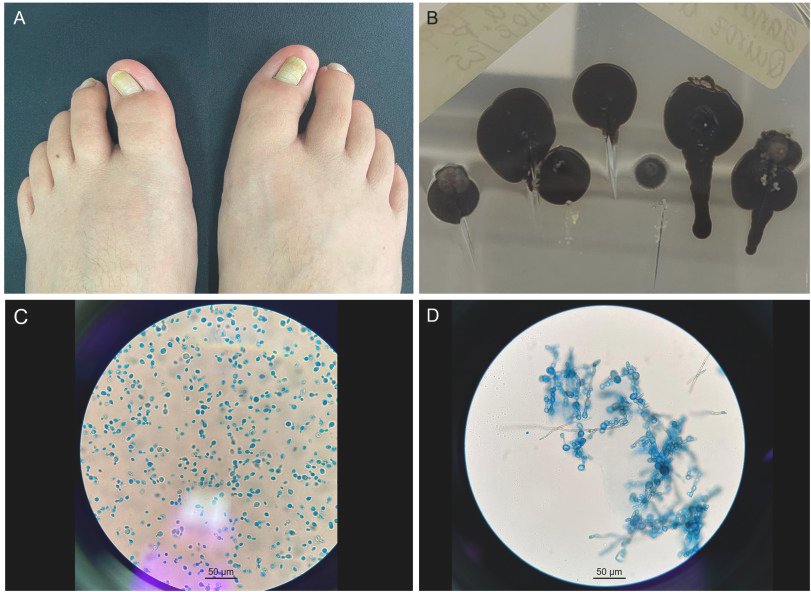
On examination, both big toenails showed marked yellowish discoloration, along with malalignment of the nail plates. The remaining nails, the soles of the feet, and the spaces between the toes were normal. Multiple nail clippings and subungual debris were collected from both affected nails to increase the likelihood of detecting the causative organism.
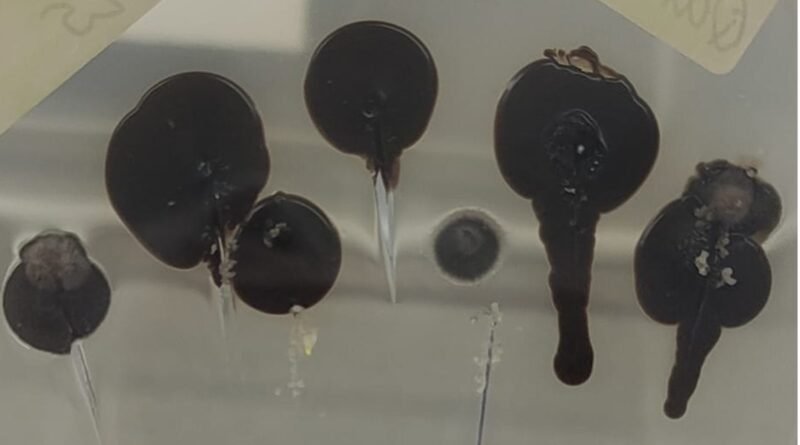
Direct examination of the samples did not reveal any fungi. It was only after 30 days of culture that dark-pigmented, mucoid, yeast-like colonies appeared.
“This is the first time that Exophiala alcalophila is reported as a causal agent of onychomycosis in the world”
Microbiologists initially attempted to identify the fungus using MALDI-TOF mass spectrometry, but the method did not produce an identification. They then performed molecular analysis of ribosomal DNA. Sequencing of a region encompassing ITS1, 5.8S, ITS2, and parts of the surrounding ribosomal genes identified the organism as Exophiala alcalophila, a very rare species within the genus Exophiala. To date, it has only been sporadically isolated from soil, household environments, and human skin, but it had not previously been known to cause human disease. According to the authors of the report, this is the first reported case of onychomycosis caused by E. alcalophila.
“To our knowledge, however, this is the first time that Exophiala alcalophila is reported as a causal agent of onychomycosis in the world, notably in a healthy patient. This species, very uncommon in the genus Exophiala, has a restricted geographical distribution, isolated scarcely from soil, households, and human skin, but never causing disease in human hosts. This case report is therefore very interesting due to the rarity of such infections, calling upon dermatologists to pay attention to black yeast-like fungi, to establish their role in superficial infections, such as onychomycosis, even in the immunocompetent.”Rueda-Jaime et al.
No other fungi were detected, and the cultures produced abundant growth of the same organism.
The patient declined antifungal treatment for personal reasons. During follow-up, the nail lesions remained stable, with no spontaneous improvement. “Importantly, dermatologists should be aware that onychomycosis can trigger more complex infectious lesions in other parts of the body. Further studies are needed to elucidate the natural habitat of E. alcalophila and other black yeast-like fungi, to determine the possible transmission and infection routes, and to estimate the real prevalence of infections caused by emerging fungal pathogens, which could be highly underestimated,” the authors concluded.
Image: Dark-pigmented, mucoid, yeast-like colonies resulting from culture of nail scrapings. Rueda-Jaime et al.
