


Why Do We Become Attached to Luxury Brands?
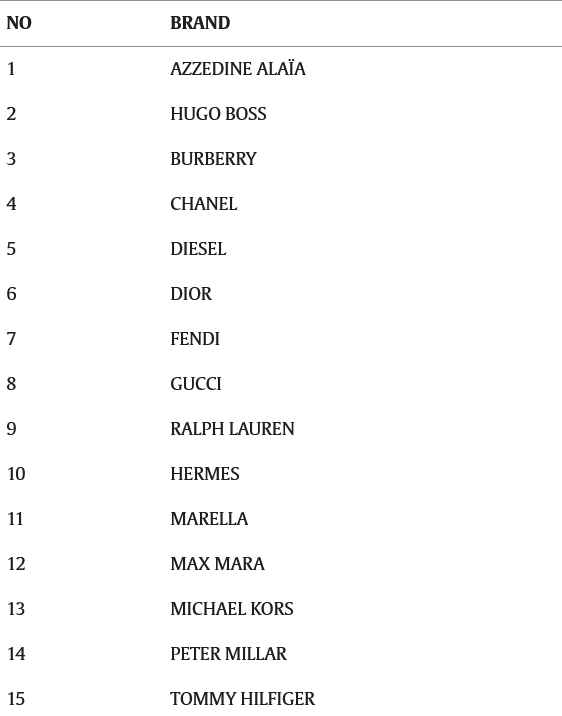
Azzedine Alaïa, Hugo Boss, Burberry, Chanel and Diesel ranked among the first five of the fifteen luxury fashion brands included in a study of consumers in South Africa. This raises a simple question: why are people willing to place greater value on some luxury brands than others?
A study published in the Journal of Retailing and Consumer Services looked at this question by examining the role of experience, stories and symbolism in the way consumers relate to luxury brands. The authors of the study “Experiential and Symbolic Pathways to Luxury Fashion Brand Equity: The Contingent Role of Brand Attachment and Subjective Norm” are Re-an Müller and Isaac Sewornu Coffie, from the School of Management Sciences, Marketing Department, North-West University, Vanderbijlpark Campus, South Africa.
The researchers were particularly interested in whether these elements were connected to emotional attachment to a brand and whether that attachment was reflected in how consumers judged the brand’s overall value. The study involved 544 luxury fashion consumers in South Africa. All participants were over 18 and had purchased a product from one of the brands included in the study during the previous six months. They then selected the brand they preferred most among those they had purchased and answered questions about their relationship with it.
Consumers do not only look at the material, design or practical qualities of a product
One of the main factors examined was brand experience. This refers to the different reactions a consumer has when interacting with a brand, including emotional, sensory, physical, and intellectual responses. More broadly, it can involve the product itself, communication, advertising, and other situations in which consumers come into contact with a brand. In luxury fashion, this kind of experience can be particularly important. Consumers do not only look at the material, design or practical qualities of a product. They also respond to how a brand makes them feel and to the associations they have with it. The second factor was what the researchers called brand mystery. The term refers to the stories, symbols and meanings that become associated with a particular fashion house over time. In the study, brand mystery included narrative, iconic, legendary and aspirational elements. A fashion house’s history, recognisable products, associated public figures, self-presentation, and sense of exclusivity can all become part of its story. As a result, a product can come to mean much more to a consumer than its practical purpose. The results showed a positive and statistically significant relationship between brand experience, brand mystery, and emotional attachment.
Within this sample, experience was therefore more strongly associated with attachment than the stories, symbolism and aspirational meanings surrounding the brand. This does not mean that experience causes attachment. Since the study was conducted at a single point in time, it can show that certain factors are related, but it cannot establish with certainty what causes what. Emotional attachment was also positively associated with greater consumer-based brand equity. In the study, this included consumers’ assessments of perceived quality, uniqueness, loyalty and the overall value of the brand, people who felt more attached to a particular brand tended to evaluate it more positively. This applied to their perceptions of quality and distinctiveness, as well as their loyalty to the brand.
The authors also connect this relationship with the possibility that a brand can become an important part of a consumer’s psychological and identity-related experience. This means that the idea should be understood as a theoretical explanation of the findings rather than evidence that buying a luxury brand directly changes how people see themselves. The relationship between attachment and brand value was also influenced by the way consumers perceive the expectations and opinions of people who matter to them. When this social influence was weaker, the relationship between brand attachment and brand value was stronger. Among consumers who perceived stronger social expectations, the relationship was weaker, although it remained positive. In other words, a person’s own relationship with a brand was still associated with a more favourable evaluation of that brand, even when the opinions and expectations of others were taken into account. The difference was that the relationship became somewhat weaker. The authors described the size of this moderating effect as small to moderate.
The product itself is not the only thing that shapes how a brand is evaluated
The study also has several important limitations. The data were collected at a single point in time through a survey, so the findings cannot establish clear cause-and-effect relationships. For example, the fact that brand experience, attachment and brand value are related does not automatically mean that one causes another. It is also important to note that the participants were all consumers in South Africa and that the study focused specifically on luxury fashion. The findings therefore cannot simply be applied to other markets or other luxury categories, such as jewellery, watches, cars, cosmetics or hospitality. The sample was recruited through a commercial online panel, which also means it may not fully represent all luxury fashion consumers in South Africa.
Even so, the study offers a useful picture of one part of the relationship consumers develop with luxury brands. The product itself is not the only thing that shapes how a brand is evaluated. The experience consumers have with the brand, the stories surrounding it and the meanings they attach to it also matter. In this study, brand experience and brand mystery were associated with stronger emotional attachment, while greater attachment was associated with more favourable evaluations of quality, uniqueness, loyalty and overall brand value.
What the study does show is that people’s relationship with a luxury brand is not based solely on what is contained in the product itself. Part of its value is also built through the experiences, stories and meanings that consumers gradually associate with the name on the label.
Image: Alaïa
