


The other side of relationships and female satisfaction
For decades, treatments for erectile dysfunction have been judged by a simple question: does it work for the man? A new study suggests that’s only half the picture.
Researchers in France set out to explore this overlooked dimension by focusing on couples in which the men underwent penile implant surgery, a device used when medication fails to restore erections. Satisfaction rates among men are typically high. But what happens on the other side of the relationship?
The study ‘Quality of life of female partners of patients who underwent penile prosthesis implantation: A multicenter retrospective study’ was authored by Félix Pironin, Nicolas Vedrine, Laurent Guy, Angèle Reichenbach, Marc Gigante, and Pierre Gayrel.
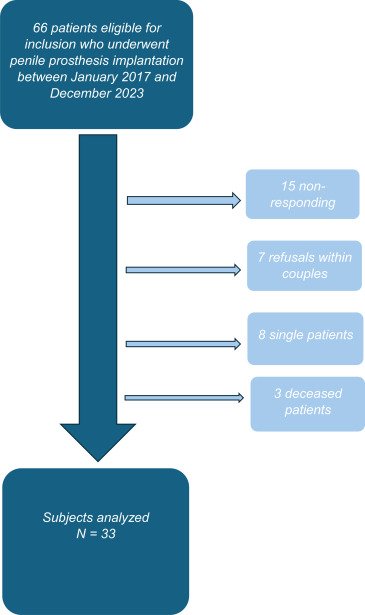
According to the study, 33 couples were included, with patients undergoing implantation between January 2017 and December 2023 at the University Hospitals of Réunion and Clermont-Ferrand and at the Bon Secours Clinic in Puy-en-Velay. “A telephone interview was conducted with the patient and his partner, and a pre- and postoperative questionnaire was administered to the partner to assess the improvement in her sexual quality of life following surgery…Inclusion criteria required patients to have received a penile implant and to be in a stable relationship with a female partner who consented to participate in the study,” the authors explained.
“Erectile dysfunction is a very common condition in the French male population, starting as early as the age of 40…. It is estimated that one in three men over the age of 40 experiences erectile difficulties, and this proportion rises to approximately 50% in men over 50. Nowadays, penile implantation is a second-line treatment after pharmacological therapies, with a high rate of satisfaction. Female satisfaction, on the other hand, is poorly studied, despite its crucial importance in the context of a couple. The aim of this study is therefore to investigate the sexual quality of life of partners of patients who have undergone penile implantation.”
It’s not just about restoring function; it’s about restoring connection
On average, measures of sexual wellbeing including desire, arousal, orgasm and comfort improved dramatically, the results showed. The improvement wasn’t uniform, however. Some factors played a surprisingly strong role in shaping outcomes. Women reported better experiences when their partners felt confident and satisfied with the implant itself. Perhaps most telling was the role of communication and involvement. Women who felt included in the treatment process, discussing options, understanding the device, and participating in decisions reported far higher levels of sexual wellbeing. In contrast, those who felt sidelined experienced much less improvement.
“Prior to implantation, 100% of female partners exhibited sexual dysfunction. After surgery, this rate dropped to 48.5%.”
This points to a broader truth about sexual health: it is rarely an individual issue. Instead, it unfolds within relationships, shaped by emotional and psychological dynamics between partners. Interestingly, some factors that might seem important turned out not to be. Complications after surgery, for example, did not significantly affect women’s reported satisfaction. Health conditions such as cardiovascular disease, however, did appear to make a difference. Women whose partners had no such conditions tended to report better outcomes. The researchers note that satisfaction may also be influenced by whether the procedures are performed in specialised centres.
The study is relatively small, and its retrospective design means it relies on memory rather than real-time tracking. Treating erectile dysfunction successfully involves more than restoring erections. It requires attention to the shared experience of intimacy. For couples themselves, the findings offer a hopeful perspective, because the key may lie not only in technology, but in partnership.
