

VUB and Universitair Ziekenhuis Brussel: New preliminary evidence suggests that a nerve test may help select patients for the treatment of life-threatening arrhythmias
When people have heart rhythm problems that don’t improve with medication and a procedure called catheter ablation, doctors may suggest a surgery called cardiac sympathetic denervation. During this surgery, the doctor interrupts part of the sympathetic nerve pathways that influence the heart, which can allow the heart to function more normally.
This procedure can be effective for some patients. But it’s hard for doctors to know which people will benefit and which won’t. A new study suggests that a simple test may help doctors identify which patients are more likely to benefit from this procedure.
“This study shares the results of our experience with cardiac sympathetic denervation at a single high-volume European center. Freedom from ventricular arrhythmias was achieved in 60% of our sample.” Doundoulakis et al., Heart Rhythm O2 (2026).
Belgian scientists from Vrije Universiteit Brussel (VUB) and Universitair Ziekenhuis Brussel (UZ Brussel) presented preliminary evidence in a study titled “Does acute response to stellate ganglion block predict the success of cardiac sympathetic denervation? Preliminary evidence.” The authors of the study are Ioannis Doundoulakis, Luigi Pannone, Roberto Scacciavillani, Domenico Giovanni Della Rocca, Gezim Bala, Juan Sieira, Gian Battista Chierchia, Mark La Meir, Andrea Sarkozy, and Carlo de Asmundis.
How does it work?
The doctors used a test called stellate ganglion block (SGB). The stellate ganglion is part of the sympathetic nervous system and transmits signals that regulate heart function. During the procedure, doctors use ultrasound guidance to inject a local anesthetic around this nerve structure, temporarily blocking its activity without permanently cutting the nerve. If the arrhythmia improves after the anesthetic is administered, this suggests that excessive sympathetic activity may play an important role in initiating the arrhythmia. In this situation, treatment with CSD may be more likely to be beneficial. If there is no response to the block, other mechanisms may be contributing to the arrhythmia, and the patient may be less likely to benefit from CSD.
Results in practice
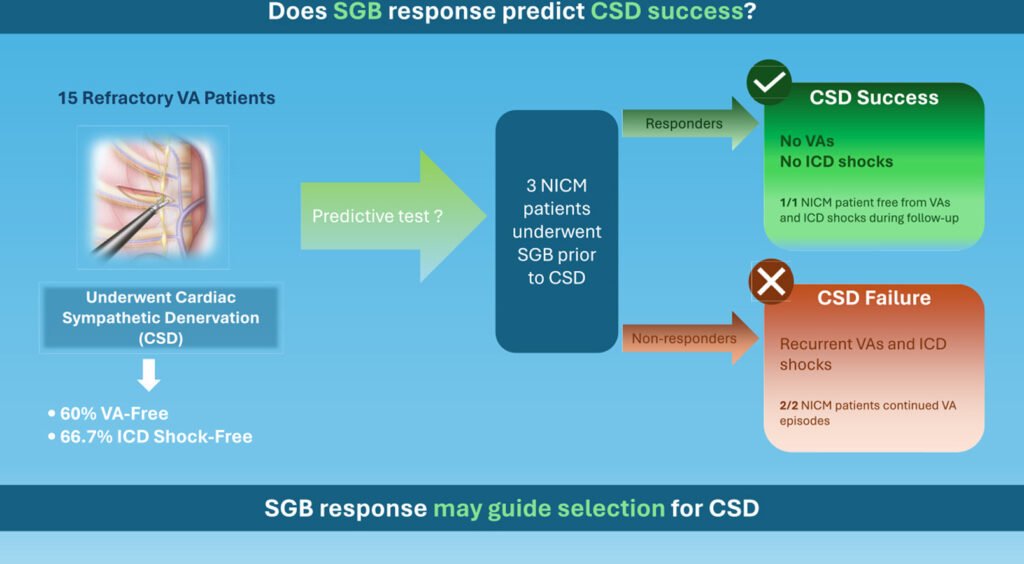
The medical team analyzed 15 patients with severe arrhythmias who were followed for an average of about 80 months. The procedure showed favorable outcomes. 60% of the patients remained free of recurrent arrhythmias, and two-thirds no longer experienced shocks from their implanted cardioverter-defibrillators (ICDs). No deaths or major complications were reported.
“We retrospectively analyzed 15 consecutive adult patients (mean age 41.8 ± 21.1 years, 33.3% female) who underwent CSD at our center between October 2015 and February 2020 for refractory VA despite optimized antiarrhythmic therapy and previous catheter ablation (mean 3.4 ± 1.8 procedures). All patients signed an informed consent that had been approved by our institutional review board. This study complied with the Declaration of Helsinki as revised in 2013 and was approved by the ethics committee.” Doundoulakis et al., Heart Rhythm O2 (2026).
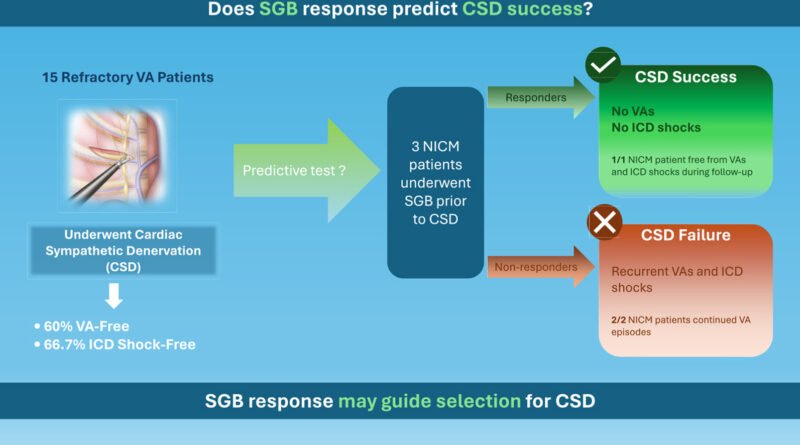
The most significant findings came from three patients with so-called “electrical storms” (episodes of recurrent, life-threatening arrhythmias). Before surgery, SGB was successful in only one of these patients, and it stopped the electrical storm. In the remaining two patients, the test had no significant effect. The patient who responded to the SGB remained free of recurrent arrhythmias and ICD shocks during long-term follow-up. Patients who did not respond to the test continued to experience arrhythmias even after surgery.
What this means for patients
Instead of taking patients straight to surgery with uncertainty about whether the procedure will work, doctors can first perform a temporary nerve block. If that fails, the patient can avoid surgery that is less likely to help. This allows doctors to consider other treatment options. Although the study was small, this appears to help doctors make decisions about how to treat heart rhythm problems. Cardiac sympathetic denervation may be beneficial for some patients, and the stellate ganglion block test may help identify those who are more likely to respond. “Larger, prospective studies are needed to validate SGB as a predictor of CSD response across substrates and to refine patient selection for this adjunctive therapy in refractory VA,” they concluded.
Image: Doundoulakis et al., Heart Rhythm O2 (2026).
Disclosures: A.S. received research grants from Daiichi Sankyo and Bayer, has received speaker fees from Menarini and Bayer, and is a consultant for Biosense Webster, Medtronic, Biotronik, and MicroPort. G.B.C. received compensation for teaching purposes and proctoring from Medtronic, Abbott, Biotronik, Boston Scientific, and Acutus Medical. M.L.M. is a consultant for AtriCure. C.d.A. receives research grants on behalf of the center from Biotronik, Medtronic, Abbott, LivaNova, Boston Scientific, AtriCure, Philips, and Acutus. The other authors have no conflicts of interest to disclose. Funding Source: This research did not receive any specific grant from funding agencies in the public, commercial, or not-for-profit sectors. Patient Consent: All patients signed an informed consent that had been approved by our institutional review board. Ethics Statement: This study complied with the Declaration of Helsinki as revised in 2013 and was approved by the ethics committee.
These publications were produced as part of the Maria Leptin EMBO Fellowship, which allowed us to spend two months exploring the world of science at VUB in Brussels. Importantly, all articles were the result of our own choice of topics and in accordance with our interests.
