

Study from Flanders, Belgium Reveals Hidden Loneliness Among Childless Adults
A new study conducted in Belgium reveals that adults without children are more prone to different forms of loneliness, but this varies depending on age. Although loneliness is increasingly recognized as a public health issue associated with a higher risk of premature mortality and mental illness, the scientific community has so far lacked a clear answer to the question, are people without children truly lonelier?
Research published in the Journal of Family Issues under the title “A Life Without Children: Unpacking the Relationship Between Childlessness and Loneliness in Adulthood,” by authors Jasper De Witte and Hannelore Stegen, provides deeper insight. “In this article, we investigate the relationship between childlessness and loneliness among adults of all ages in Flanders, Belgium. For this, we do not only take into account different age groups since the relationship between loneliness and childlessness presumably depends on the specific life stage people are in, but we also include different loneliness types (social, emotional, and existential loneliness),” they wrote in the study.
“Since the second half of the 20th century, an increasing part of the population in Europe and worldwide remains childless, whether voluntary (due to increased education of women, and contraceptive methods which allow women to develop their careers) or involuntary (due to infertility, divorce of delayed partnership) . The number of childless women of the cohort born around 1965 already forms 10% to 20% of the population in Europe…Research shows that about 36% of adults in Europe feel lonely at least some of the time, and about 13% feel lonely most or all of the time…Research on the relation between childlessness and loneliness is limited and inconclusive. While some studies link childlessness to higher loneliness, others find no association. Few studies distinguish between distinct loneliness types (social, emotional, and existential) or life stages.” De Witte and Hannelore (2026)
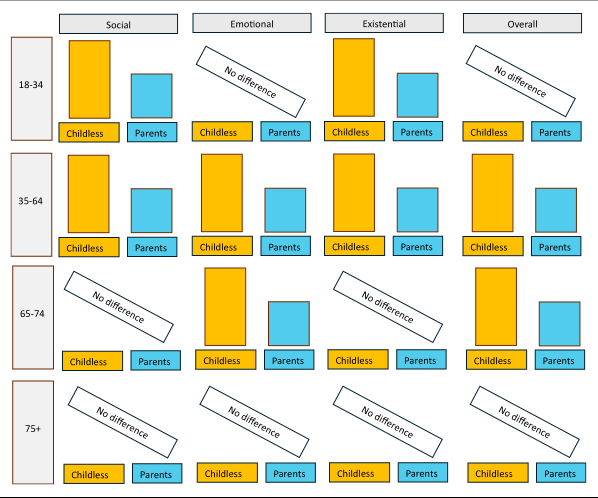
For the age group 35–64 years, this difference is significant for all loneliness variables
The results show that, on average, people without children are lonelier across all categories. However, the picture becomes much more complex when the data is analyzed across different life stages. “33.8% of the sample was childless. We find that older adults and women are less likely to be childless than younger adults and men. Parents are more likely to be pensioned (36%) and less likely to be full-time employed (34%) than childless adults ( 15% and 44%, respectively). We find no difference between adults with or without children with regard to household income, and childless adults have a better self-rated health than parents. Last, two-thirds of the parents are married, in comparison to only 21% among those without children. In this respect, variables such as education level, employment status, self-rated health, and childlessness are strongly related to the age of the respondents. We deduct that adults without children are significantly lonelier than parents, and this for all four loneliness variables (overall, emotional, social, and existential loneliness). However, for the age group of 18–34 years, this difference is only significant for social and existential loneliness. For the age group 35–64 years, this difference is significant for all loneliness variables. For the age group 65– 74 years, this difference is only significant for overall and emotional loneliness, and for adults of 75+ this difference is not significant for any of the loneliness types,” they explained.
How was the research conducted?
The study is based on a large-scale project titled “A Lonely Planet,” carried out in 2024 in Flanders (Belgium), funded by the Research Foundation Flanders (FWO). A total of 3,756 adults participated. Data were collected through online and paper questionnaires available in Dutch, English, and French. The study focused on the Flanders region and aimed to clarify findings from previous research, which often did not distinguish between types of loneliness or consider the full spectrum of adulthood.
These findings have direct implications for public health. As the number of childless individuals continues to grow, society must develop new support systems. “More research is needed in order to provide more in-depth knowledge about the possible implications of childlessness on different loneliness types, while taking into account the distinct life stages. In this respect, our research suggests that having children is never associated with higher loneliness levels, and—depending on specific contextual factors—may be related to lower loneliness levels. Indeed, it is crucial to broaden our view of the traditional family model when studying well-being, the need for care and support, and loneliness, by also including the increasing amount of older childless adults in Europe and worldwide,” the authors concluded.
Image: What is Causing Our Epidemic of Loneliness and How Can We Fix It?
