

A rare complication after facial fat grafting
Facial fat grafting is a well-established procedure in aesthetic, reconstructive surgery. It is used to restore soft-tissue volume and improve the appearance and quality of surrounding tissue. However, a case reported in Oral and Maxillofacial Surgery Cases describes an unusual complication following fat grafting to the temporal region: temporary facial nerve palsy followed by hair loss in the treated area. The authors of the case report “Transient alopecia and transient facial nerve palsy following scalp autologous fat grafting: a case report of an unusual complication” are Daniel-Adrien Wurlod, Martin Broome, and Laurence May.
The patient was a 37-year-old Georgian man who had suffered severe cranial trauma in a traffic accident in Georgia in 2012. The accident resulted in skull fractures and loss of vision in his right eye. He subsequently underwent several surgical procedures. Because of post-traumatic bone loss, which had resulted in facial deformity and asymmetry, a PEEK (polyetheretherketone) prosthesis had been used to replace almost the entire frontal bone. Fat grafting to the temporal and nasal regions was then planned to improve the surrounding soft tissues and the shape of the skull.
A sudden facial nerve palsy
For the procedure, 60 millilitres of fat were harvested manually by liposuction from the abdomen and the lateral aspects of the thighs. Fifteen millilitres were injected into the hypodermis of the temporal region and five millilitres into the nasal region. Three hours after surgery, the patient developed a grade 4 left facial nerve palsy according to the House-Brackmann scale. He was able to close his eye actively with effort but was unable to raise his forehead. A slight temporal induration was also noted and led to the diagnosis of a haematoma. Because the haematoma was not under tension and the surrounding tissue remained soft, decompression was not considered necessary.
The following day, the facial palsy had already partially improved, while bruising had developed in the operated area. Five days after surgery, the patient was able to close his eye easily. Small vesicles then appeared at the periphery of the operated temporal area. Tests for varicella-zoster virus and herpes simplex virus types 1 and 2 were negative. The vesicles followed a favourable course and disappeared within seven to ten days.
Hair loss appears one month later
One month after surgery, the facial nerve palsy had completely recovered. However, hyperpigmentation had developed locally in the temporal region, together with complete hair loss in the injected area. The affected area measured approximately 5 by 13 centimetres. Six weeks after surgery, fine hairs that were firmly attached to the underlying scalp and resistant to pulling began to grow. After three months, hair regrowth was steadily improving. “Transient alopecia is a rare worth recognizing complication as it can lead to unneeded stress for the patient and for the surgeon,” the authors noted.
Why did the hair disappear?
The authors propose that the temporary facial nerve palsy and the hair loss may have been caused by compression from the immediate postoperative haematoma. The study cannot establish which mechanism was responsible for the hair loss. Hair loss can be classified as either scarring or non-scarring alopecia. In non-scarring alopecia, the hair follicle is preserved, whereas scarring alopecia involves loss or destruction of the follicle. The appearance of new hair approximately six weeks after surgery and the continued recovery over the following months indicated that the follicles had not been permanently destroyed.
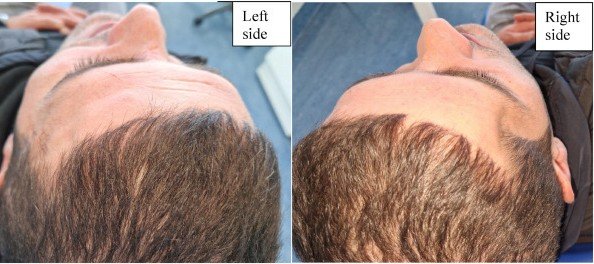
The authors note that only one other case of alopecia following facial fat grafting had previously been reported. In this patient, no treatment specifically directed at the hair loss was required. Two years after surgery, photographs showed recovery of hair growth in the previously affected area. The colour and consistency of the hair were similar to those on the opposite side, although the density remained slightly lower. The authors conclude that transient alopecia is a rare but important complication to recognise after facial fat grafting. Although its appearance can cause considerable concern for both the patient and the surgeon, in this case, the outcome was favourable, with complete recovery of facial nerve function and substantial recovery of hair growth without specific treatment for the alopecia.
Image: Fat Transfer To Face Sydney
Statement for studies in humans: This case report describes a complication that occurred postoperatively in a patient. The patient gave his informed consent for the publication
