


What 125 European Commission Press Releases Reveal About Resilience, Finance and Ukraine’s European Path
After Russia’s invasion of Ukraine began, European Commission press releases focused heavily on the war, financial assistance, and immediate crisis measures. As the war continued, the language used by the Commission to describe its support for Ukraine also changed.
An analysis of 125 European Commission press releases published in English in the Commission’s Press Corner between 1 March 2022 and 30 June 2025 shows a gradual rebalancing in the language used to describe support for Ukraine, with increasing emphasis on resilience, recovery, territorial references, and themes associated with European integration, while solidarity and security remain present.
The study was authored by Professor Sébastien Bourdin from the IESEG School of Management in Lille, France, and is titled “Resilience and Solidarity in European Commission Communication on the War in Ukraine: Instruments, Territories and Integration Signals.”
Resilience, solidarity, unity and security
The analysis focused on four key registers: resilience, solidarity, unity and security. These were then examined in relation to specific instruments and sectors, including finance, energy, trade, transport and territorial terms.
The corpus contains 125 press releases, with a total length of around 122,000 words. For each occurrence of a key register, the six words before and six words after it were examined. The aim was to identify which themes and policy instruments appeared most often in close proximity to particular terms.
One of the measures used was PMI, or pointwise mutual information, which indicates how strongly two terms are associated relative to what would be expected from their individual frequencies. A log-likelihood ratio was also used as an additional statistical measure to assess differences in co-occurrence. The results were checked across both narrower and broader contexts, using windows of four, six, and eight words before and after a given term.
These measures do not show that one word causes another, nor can they demonstrate that the Commission’s language produced any particular policy decision. They are instead useful for identifying stronger and more consistent patterns of association across a large body of text.
From broad political language to concrete instruments
One of the clearest patterns in the analysis is that key political terms increasingly appear alongside specific policy instruments.
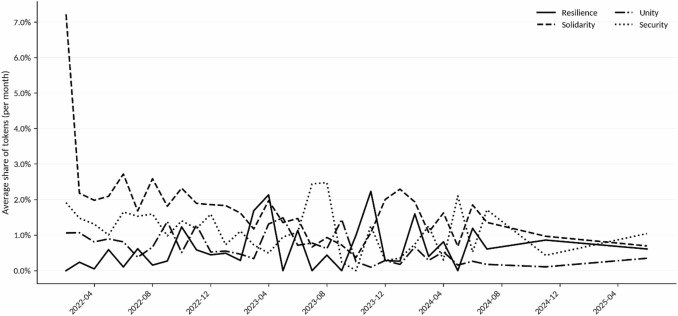
Solidarity was particularly prominent at the beginning of the crisis, when communication was largely focused on the immediate response to the war. Later, resilience became more prominent, especially during 2023, as support was increasingly described through longer-term programmes, financial instruments, energy stability and recovery. Security appeared more strongly during periods associated with sanctions, while later press releases also linked it to the protection of infrastructure, energy systems and transport routes.
Taken together, these patterns suggest that political language increasingly appeared alongside concrete instruments and areas of policy.
Resilience was closely linked to concrete policy instruments
The clearest example is resilience. According to the analysis, 36.6 per cent of all occurrences of the word stem “resilien-” covering both “resilience” and “resilient” appeared within six words of at least one term relating to finance, energy, trade, or transport.
The strongest financial associations were with words and phrases such as facility, disbursement, guarantee and financial. In the Commission’s discourse, resilience therefore frequently appeared in close proximity to concrete policy instruments and sectors. This pattern remained relatively stable over time. In 2022–2023, around 36.8 per cent of occurrences of resilience were associated with financial, energy, trade or transport terms. In 2024–2025, the figure was 35.7 per cent. Energy was another important connection. REPowerEU, gas, electricity and energy appeared frequently alongside resilience. In the Commission’s language, resilience was therefore often discussed in relation to energy networks, supply and energy security.
Solidarity and unity increasingly appeared alongside integration-related language
The use of the words “solidarity” and “unity” also changed over time. In the earlier period, they were more often associated with language describing a common response to the crisis. Later, they appeared more frequently alongside terms such as “European”, “accession”, “alignment”, “market” and “cohesion”.
For the purposes of this analysis, integration-related terms refer to the predefined group of terms associated with European rules, accession, alignment, the European market and cohesion. The share of occurrences of “solidarity” and “unity” that had at least one predefined integration-related term within a ±6-word window increased from 8.7 per cent in 2022–2023 to 29.6 per cent in 2024–2025. These figures refer specifically to solidarity/unity occurrences and are not percentages of all press releases or of the corpus as a whole.
This does not mean that Ukraine’s EU membership was predetermined. Rather, it points to a change in how the relationship between the EU and Ukraine was presented publicly: European rules, the market, alignment and cohesion became more visible elements of that language.
A similar pattern emerges when looking at the number of press releases in which particular themes appeared together. Solidarity appeared alongside macro-financial and budgetary support in 60 press releases, and alongside transport in 60 press releases. For unity, the corresponding figures were 56 and 57. Trade and alignment appeared alongside solidarity in 52 press releases, and alongside unity in 50.
Territory becomes more visible
In the later period, terms relating to borders, regions, cohesion, corridors, local government and municipalities appeared more frequently. The rate of territorial terms increased from 2.07 per 1,000 words in 2022–2023 to 7.49 per 1,000 words in 2024–2025.
Borders appear as places where the movement of people and goods needs to be maintained. Corridors are discussed in connection with trade and humanitarian transport. Municipalities are mentioned in relation to local services, capacity and investment, while regional administrations appear alongside projects, funding and alignment with European rules. These patterns are consistent with a shift towards language describing the territorial and administrative dimensions of longer-term recovery and cooperation.
How the language changes around key events
The shift is visible around major political and programme-related events. The figures below represent average rates within the six words preceding and following the term, rather than counts on the day of the event itself.
The Ukraine Recovery Conference in Berlin on 11 June 2024 was associated with 11.4 financial terms per 1,000 words, 13.3 transport terms and 12.1 integration-related terms. On 17 July 2024, when the Commission gave a positive assessment of the conditions for the first regular payment of close to €4.2 billion under the Ukraine Facility, financial terms reached 14.5 per 1,000 words, while integration-related terms reached 11.6. The Commission stated that the proposed payment was linked to Ukraine’s fulfilment of agreed reform and investment indicators under the Ukraine Plan. On 30 June 2025, when the EU and Ukraine reached an agreement in principle on the review of the DCFTA, trade and market-related terms reached 35.6 per 1,000 words, while integration-related terms stood at 15.8. The agreement in principle was reached on 30 June 2025; the revised framework subsequently entered into force on 29 October 2025.
It is important to distinguish the date of the agreement in principle from the later entry into force of the revised framework. These figures do not show that the events themselves caused changes in the language. Rather, they show that finance, transport, trade and integration-related terms appeared particularly strongly during periods when specific instruments and programmes were prominent in the Commission’s communication.
An increasingly visible link to European integration
The shift can also be seen in the relationship between the word “Ukraine” and terms associated with European integration. The PMI association between “Ukraine” and “accession” rose from 3.87 in 2022–2023 to 4.42 in 2024–2025. The association with “alignment” increased from 3.29 to 4.20.
This pattern may be interpreted as consistent with what can be described as discursive pre-legitimation of integration: references to European rules, alignment, markets and cohesion increasingly make integration a more familiar part of the public policy language used to describe the EU’s relationship with Ukraine. This does not mean that there was a coordinated communication strategy or a predetermined political intention, nor does it suggest that the outcome of Ukraine’s membership process had been decided in advance. This is an interpretation of the observed linguistic pattern, rather than a claim that the statistical measures themselves establish a political intention or predetermined outcome.
There is also a clear institutional context for this broader pattern. The Ukraine Facility, which covers the 2024–2027 period and provides up to €50 billion in grants and loans, explicitly combines support for Ukraine’s recovery, reconstruction and modernisation with reforms connected to its EU accession path. In June 2024, the EU formally opened accession negotiations with Ukraine, following the European Council’s December 2023 decision and the Council’s approval of the negotiating framework on 21 June 2024.
Integration, therefore, does not appear only in the context of a formal accession decision. It can also become part of the everyday language of policy through rules, financial instruments, access to markets and the way institutions and territories are discussed. The analysis does not show that membership was predetermined. Nor does it show that the Commission’s language caused any particular political decision, allocation of funds or outcome on the ground. What it does show is that language associated with European integration became a more prominent part of communication about Ukraine.
How could the findings of this study be used in the future?
As Professor Sébastien Bourdin explained “These findings can provide a baseline for tracking whether later EU communication is matched by territorial delivery, such as funding allocations, corridor investment, energy infrastructure and municipal support. Future research could compare Commission language with Council and Parliament communication, include Ukrainian and other European-language sources, and test whether shifts in discourse anticipate changes in funding or project geography. For policymakers, the results also underline the need to connect broad commitments to resilience and solidarity with visible outcomes in border regions, corridors, municipalities and regional administrations.”
From an emergency response to a long-term programme
At the beginning, the focus was on crisis response: solidarity, security and emergency support. Financial stabilisation and resilience then moved to the foreground, alongside energy and infrastructure. At a later stage, transport corridors, trade, markets and regulatory alignment occupied an increasing share of the discussion. This does not mean that earlier priorities disappeared. They remained present, but their relationship with other themes changed. Perhaps the most important finding, therefore, is not any single word but the changing relationships between words.
The study nevertheless has clear limitations. It examines only English-language European Commission press releases published in the Press Corner. It does not include speeches, interviews, material from the Council or European Parliament, or texts in other languages. The findings should therefore be understood as evidence about patterns in public institutional language, rather than as evidence of causation, political intent or predetermined policy outcomes.
The analysis, covering over 122,000 words, examines the evolution of the public discourse justifying European policy towards Ukraine. Spanning from the expression of solidarity in urgent circumstances, through financial support and energy resilience, to issues of borders, corridors, trade, and the European market, 125 press releases reveal a gradual shift in how European policy towards Ukraine was publicly presented: moving from an immediate crisis response to long-term recovery and cooperation.
Photo courtesy of Professor Sébastien Bourdin
About the study:
Declaration of Competing Interest: Hereby, we declare that there are no conflicts of interest regarding the submission of this manuscript. We confirm that there are no known relationships or involvements, either financial or non-financial, that could potentially influence or bias the work reported in this manuscript. This declaration also covers any possible conflicts pertaining to the research funding, employment, consultancies, stock ownership, honoraria, patents, or any other interests related to the subject matter or materials discussed in the manuscript.
