


Disinformation and Emotions in the 2024 US and EU Elections: How Emotions Shape What People Believe
The year 2024 was marked by major political events, especially important elections in the United States and across the European Union. In such a politically sensitive period, the space of public communication, especially on social media, becomes filled with information, but also with disinformation. At that moment, it becomes especially important to understand not only what people read, but also why certain messages have such a strong impact on the public. A study by Alba Córdoba-Cabús, Andreu Casero-Ripollés, Laura Alonso-Muñoz, and Alejandra Tirado-García, titled “Disinformation and emotions in the 2024 European Parliament and US presidential elections”, provides insight into the role of emotions in the spread of disinformation.
“In 2025, disinformation was identified as one of the main short-term global risks…Despite growing academic interest in disinformation, studies focusing on electoral contexts and their emotional dimension remain relatively scarce. Even rarer are those studies that adopt a comparative perspective between different geopolitical contexts.” Córdoba-Cabús et al.
Disinformation often spreads faster and more effectively than true information. At first glance, it may seem that the reason is a lack of knowledge or low media literacy among users. However, this study shows that the problem is more complex. It starts from the idea that not only the content of information matters, but also the emotions that this information creates.
We spoke with one of the authors of the study, Professor Andreu Casero-Ripollés, Full Professor of Journalism at Universitat Jaume I de Castelló (Spain).
Research challenge and methodology
The study begins by identifying an important gap in existing research. As the authors point out, although academic interest in disinformation is growing, studies that focus on election contexts and their emotional dimension are still relatively rare. This study aims to fill that gap.
Methodologically, the study is based on a content analysis of 622 verified cases of false information. The US part of the sample includes 374 cases of disinformation about the presidential elections, collected from the PolitiFact database between January 15, 2024, and January 20, 2025. The European part includes 248 cases related to the European Parliament elections, collected from 52 fact-checking organizations in 20 EU member states through the Elections24Check database, between May 1 and June 30, 2024.
The analysis included 17 variables, such as the channel of distribution, format, topic, actors, and the presence and type of emotions. Statistical analysis was carried out using SPSS software.
Emotions and disinformation
“Analysis of disinformation spread during the 2024 US presidential elections and the European Parliament elections reveals a notable presence of emotions in false messages. Of the total number of cases identified (n = 622), 65.5 % displayed the use of emotional appeals aimed at influencing public perception,” the authors wrote in the study.
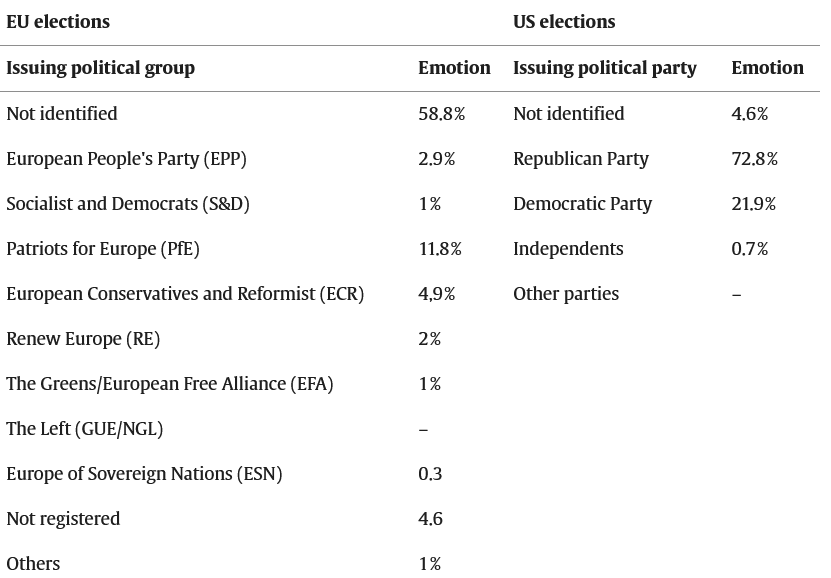
One of the most striking findings is the difference between the two contexts. In the United States, emotional elements were found in 80.7% of false messages, while in Europe this share was much lower, at 41.1%. This difference can be explained by the characteristics of the US political system, which includes stronger polarization. In contrast, the European political space is more diverse and fragmented, with less focus on individual political figures.
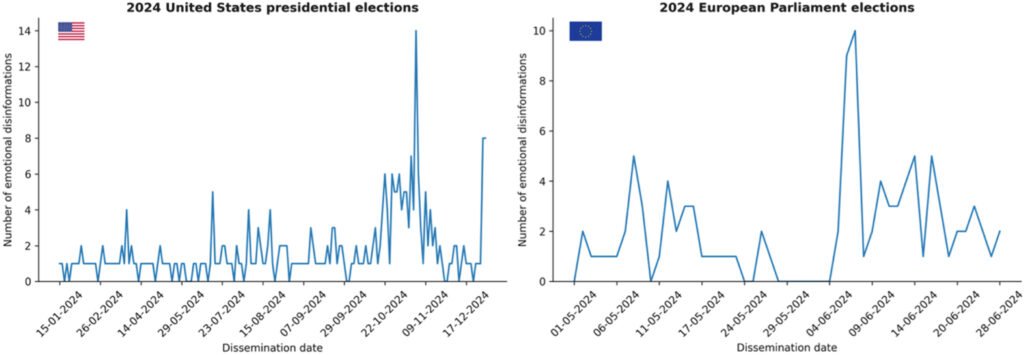
The peak of emotionally charged disinformation in the EU was recorded during the European Parliament elections, between June 6 and June 9, 2024, when it reached 8.87% of the analyzed cases.
Dominance of negative emotions
The study shows that negative emotions dominate, making up 73.4% of all emotional messages, while positive emotions account for 25.5%. The most common emotions are anger (14.6%), fear (9.8%), joy (9.6%), guilt (9.2%), and shame (9.2%). These negative emotions are used strategically to divide the public, activate biases, and weaken trust in institutions. However, the study also notes the use of positive emotions, such as joy, especially in the US context.
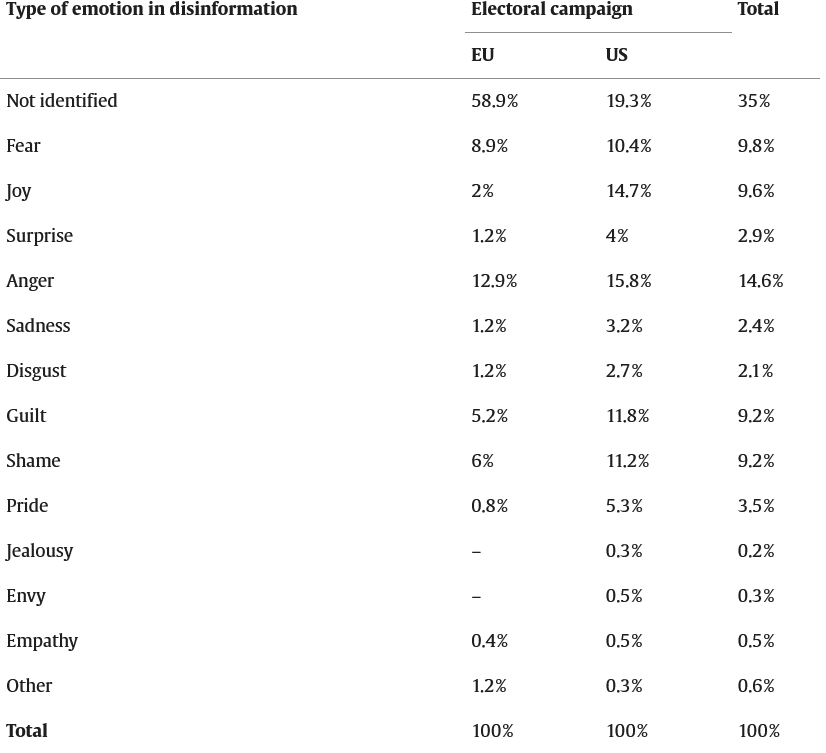
In Europe, joy was much less present (2%) compared to the US (14.7%), showing different emotional strategies depending on the political environment.
Channels and topics
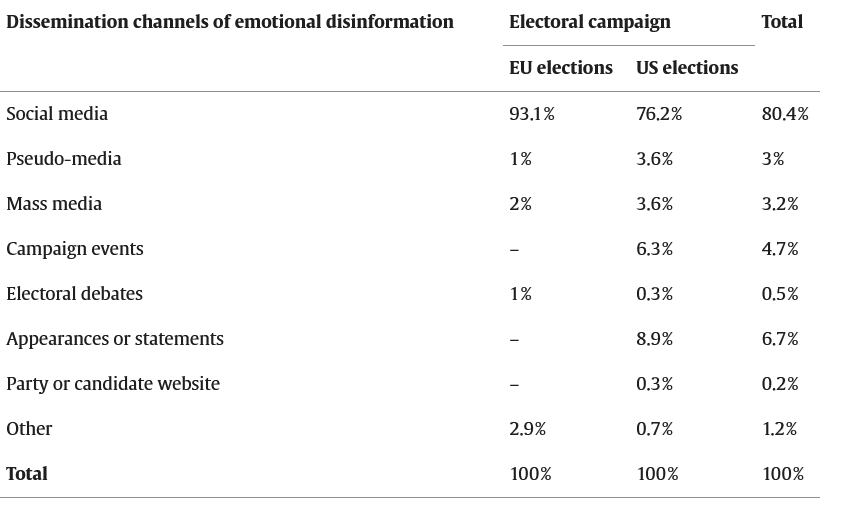
Social media are the main channel for spreading emotional disinformation, accounting for 80.4% of all cases. In the European Union, this share is even higher (93.1%), while in the US it is slightly lower (76.2%). The study did not find a strong link between the format of the content (text, video, audio, image) and the presence of emotions, which suggests that emotional impact depends more on content and context than on format.
In terms of topics, campaign-related disinformation is the most emotional, with 81.3% of content containing emotional elements. False claims about election integrity are especially common. Among public policy topics, immigration stands out as a key area for emotional disinformation, often using fear and existing biases.
Actors and targets
The study also looks at who spreads disinformation and who is targeted. The most common sources are anonymous users on social media (44.3%), followed by influencers and public figures (17.6%), and political actors (12.1%).
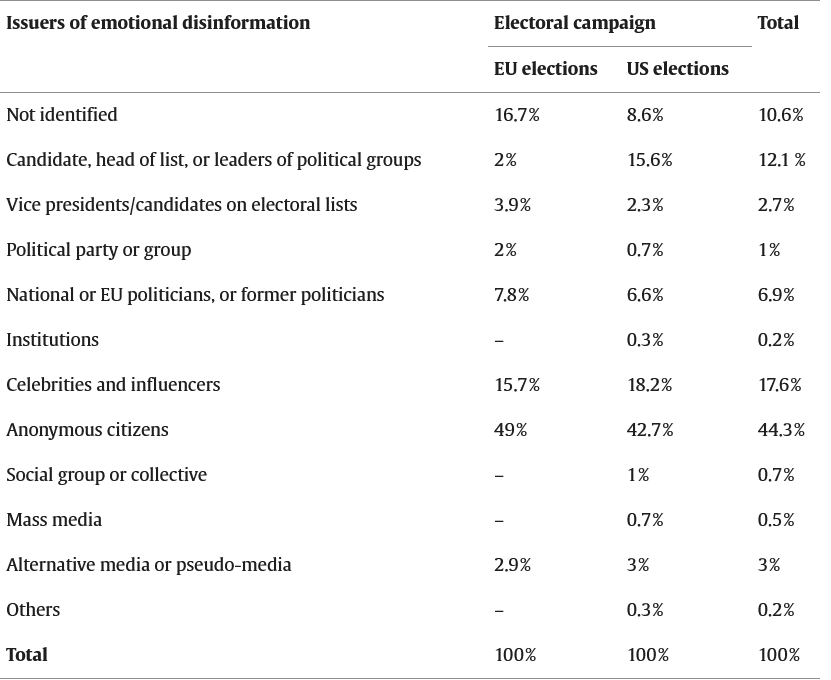
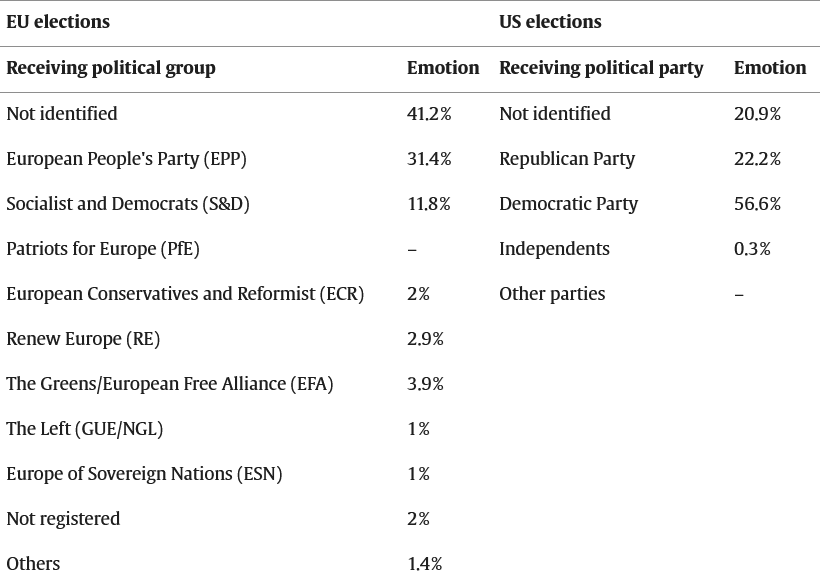
In the US, political leaders play a stronger role both as sources and as targets of disinformation. In Europe, candidates are less present as sources (2%) compared to the US (15.6%). Targets are more often institutions (24.5%) and governments (14.7%) than individual politicians.
We need greater commitment from politicians, social media, and AI companies to combat disinformation
How can this study improve political communication, and what is the key thing that should change in the way politicians communicate?
Andreu Casero-Ripollés: Our research has shown that all parties and candidates use disinformation as part of their political communication toolkit. Furthermore, they use a type of disinformation heavily weighted with emotion to enhance its impact on the public. This can lead to the manipulation of perceptions and opinions, potentially altering voting decisions and electoral behaviour. Our study highlights the need for greater responsibility on the part of politicians when communicating. It is crucial to remember that emotions have proven to be a powerful mobilising force in the political arena. Politicians should not use false content or emotional manipulation to persuade citizens. Otherwise, we risk damaging the health and quality of democracy.
Today, people often find it difficult to tell what is true and what is not. If we look at the current state of the media, social networks, and global political events, that relationship, that trust, has been damaged. Has objectivity been lost, or is it being lost? And would greater objectivity and transparency lead to more critical thinking and fewer emotional reactions among citizens?
Andreu Casero-Ripollés: Currently, a post-truth attitude prevails among many citizens, in which ideologically articulated opinions and beliefs carry more weight than objective facts. In a context of strong political polarisation, more and more citizens only give credence to those who agree with their ideological views. In this framework, objectivity ceases to be a prominent concept. Therefore, appealing to objectivity won’t solve any problems.
On the other hand, transparency can be useful. One example is disinformation content created with AI. If transparency mechanisms are applied, such as watermarks or warnings that the content is AI-generated, its potential to confuse citizens can be considerably reduced. For this to work, the commitment of politicians, digital platforms, and AI companies is fundamental. If these actors do not declare, from an ethical perspective, that certain content is generated using AI, it is difficult to enforce transparency. So far, this commitment has been weak, as evidenced by the fact that in the 2024 European elections, most parties in the European Parliament signed a code of conduct against disinformation, which was then ignored by everyone during the campaign. We need greater commitment from politicians, social media, and AI companies to combat disinformation.
Why this matters
This study shows that disinformation is not effective only because it is convincing, but mainly because it is emotionally powerful. Emotions act as a mechanism that helps disinformation spread faster, especially during key political moments. In a world where information travels fast, the ability to think critically and understand our own emotional reactions is just as important as checking facts. The study highlights the need for a broader approach to disinformation in order to develop effective ways to protect democratic systems in an increasingly complex information environment.
Image: 2024 elections are testing democracy’s health, OHCHR
Funding statement: The authors acknowledge the funding by the following research projects: CIPROM/2023/41, funded by Conselleria de Innovación, Universidades, Ciencia and Sociedad Digital of the Generalitat Valenciana under the Prometeo program; and ref. 101126821-JMO-2023-MODULE (DISEDER-EU) funded by the European Education and Culture Executive Agency (EACEA), belonging to the EU. Views and opinions expressed are, however, those of the author(s) only and do not necessarily reflect those of the Generalitat Valenciana, and the EU or EACEA. Neither the EU nor the granting authority can be held responsible for them.
Declaration of competing interest: The authors declare that they have no known competing financial interests or personal relationships that could have appeared to influence the work reported in this paper.
