


Professor Freitas-Magalhães Analyzes Rosalía’s Face During Performance, Revealing One of the Most Intense Neuroemotional Moments on Stage
As Professor Freitas-Magalhães noticed during her performance of “Mio Cristo piange diamanti” in London, Rosalía revealed one of the most intense neuroemotional expressions ever witnessed on stage.
Between the verse and the voice, this story begins, a moment in which Rosalía’s face, during the performance of “Mio Cristo piange diamanti,” became a kind of map of inner states. Emotions were not only expressed but also precisely analyzed. This is exactly what Professor Armindo Freitas-Magalhães achieved using F-M FACS 6.0, a system designed to decode the most subtle changes in human expression.
Dr. Armindo Freitas-Magalhães is a Portuguese psychologist specializing in the study of emotions and facial expression. He is a professor, psychologist, founder, and current director of the Laboratory of Facial Expression of Emotion at the Faculty of Health Sciences of the Fernando Pessoa University (UFP) in Porto, Portugal. Professor Freitas-Magalhães is known for developing the F-M FACS system, used to analyze subtle changes in the human face (microexpressions). We spoke with Professor Freitas-Magalhães about this analysis, in which he explores how inner emotional states are revealed through facial movements.
In the soft glimmer of the eyes, emotion finds its form
Observing the performance through the precise lens of F-M FACS 6.0, Professor Freitas-Magalhães records what often escapes the eye: a quiet choreography of muscles that follows the inner state. The eyebrows gently lift and draw together, while the face retains an openness. The corners of the lips subtly descend. As the voice rises, the face follows. And then, the eyes. A tearful sheen, a glimmer, the moment when light lingers on the surface of a tear. At times, the eyelids close, almost completely. In all of this, the voice softens into silence. Within this space, an emotional process emerges, one that can be seen, followed, and understood. Through this scientific, yet deeply human perspective, the professor reveals that every facial movement carries its own code.
As her voice rises toward its peak, the activation of NAU1 and NAU4 reflects deep inner tension and introspection. In the corners of her lips, which subtly descend (NAU15), he notices sadness, while the gentle movements of the cheeks (NAU6) confirm that these emotions are fully authentic and lived.
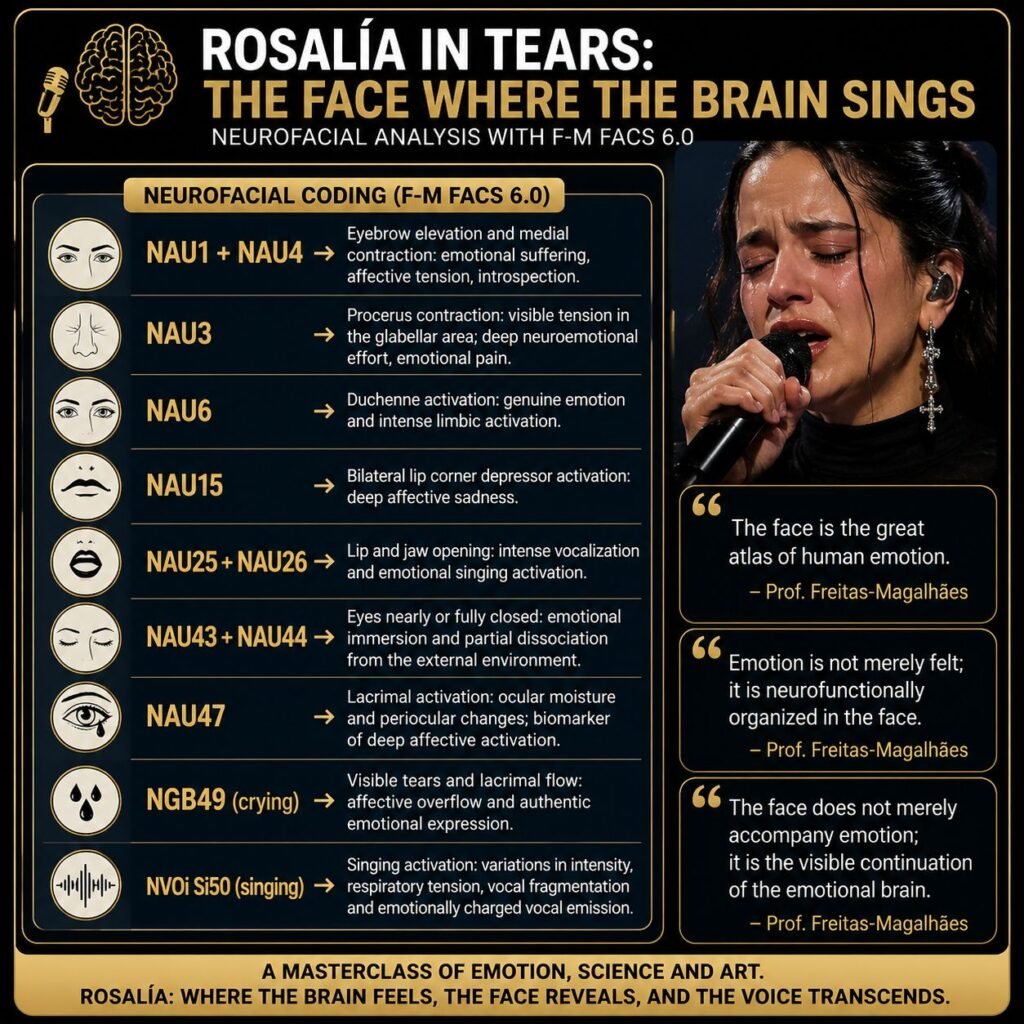
A particularly moving moment occurs at the peak of vocal intensity. Here, NAU25 and NAU26 are activated, accompanying the extreme opening of the lips and jaw, while a distinct tension appears in the region between the eyebrows (NAU3). This microexpression, identified by Dr. Freitas-Magalhães, reflects immense neuroemotional effort and the artist’s complete surrender to her own pain and catharsis. The glistening in the eyes and the moisture of the periocular region (NAU47), combined with the act of crying itself (NGB49), are not merely physiological phenomena. They are visible indicators of intense brain activity and emotional truth. In moments when Rosalía almost closes her eyes completely (NAU43 and NAU44), she withdraws from the external world. She fully immerses herself in her own inner universe, while her voice (NVOi Si50) ceases to be merely music and becomes a direct extension of her inner being.
The face did not simply accompany the song – it became part of the emotional architecture of the performance itself
How could this improve further research? What question did this open up for you?
Professor Freitas-Magalhães: This line of research may contribute significantly to future studies by helping us better understand how music, emotion, culture, and facial expression interact dynamically in real time. It opens important questions about whether emotional expression during artistic performance follows universal neurobiological patterns or whether it is shaped by cultural, linguistic, and artistic modulation. One particularly fascinating question concerns how neuromicroexpressions evolve during live performance, especially when emotion, rhythm, memory, and identity become deeply integrated.
To what extent could the language she sang in have influenced the microexpressions? What particularly impressed you?
Professor Freitas-Magalhães: Regarding language, we believe the language sung can indeed influence facial expression and neuromicroexpressive activation to some extent. Different languages involve distinct phonetic structures, muscular activations, breathing rhythms, and emotional cadences. In Rosalía’s performance, the emotional intensity associated with Spanish and flamenco-rooted vocalization appeared strongly embodied in the face, particularly through tension-release dynamics, eye behaviour, lip compression, and subtle autonomic activation. What impressed us most was the extraordinary coherence between voice, emotion, and facial activation. The face did not simply accompany the song – it became part of the emotional architecture of the performance itself. Some expressive transitions appeared almost instantaneous, suggesting a very strong integration between emotional processing and expressive motor output, which is highly significant from a neurofunctional perspective.
Sei l’uragano più bello
“Sei l’uragano più bello
Che io abbia mai visto
Il migliore dei dolmen
Si alzerebbe per te…”
Thus begins a song that illustrates how inner states can be recognized in the subtlest changes of human expression. Rosalía’s interpretation shows how emotions become visible and measurable through movement, gaze, voice, and even the glimmer in the eyes. This analysis demonstrates how a song, when shaped by genuine emotion, can also become a subject of scientific inquiry.
Image: By Junta de Andalucía – https://www.flickr.com/photos/68782198@N02/53347397631/, CC BY-SA 2.0, https://commons.wikimedia.org/w/index.php?curid=189483975
