

How Unequal Is AI Readiness in EU E-Government Systems?
A study published in the journal Telematics and Informatics provides insight into the readiness of European Union (EU) member states to integrate digital technologies into their e-government systems. The analysis reveals significant differences across countries, highlighting variations that align with existing patterns of the digital divide.
The authors of the study “Unequal AI readiness: institutional and digital disparities in e-government across the European Union” are Eduardo Amaral, Mijail Naranjo-Zolotov, and Fernando Bação.
We spoke with the corresponding study author, Mijail Naranjo-Zolotov, an Adjunct Assistant Professor at the NOVA Information Management School (NOVA IMS), Universidade Nova de Lisboa, Portugal.
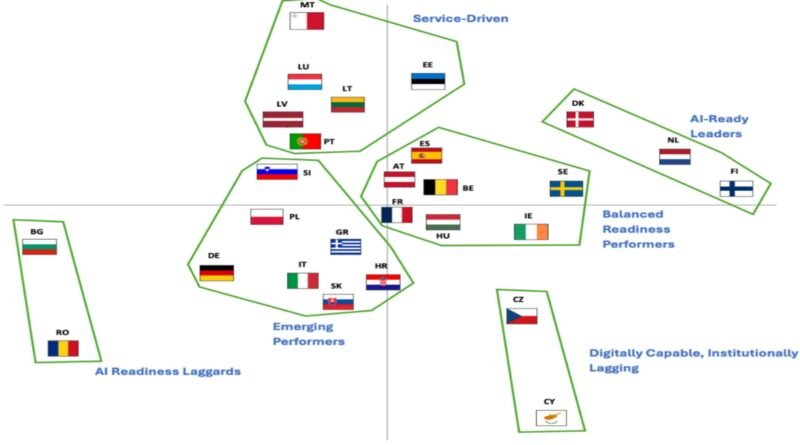
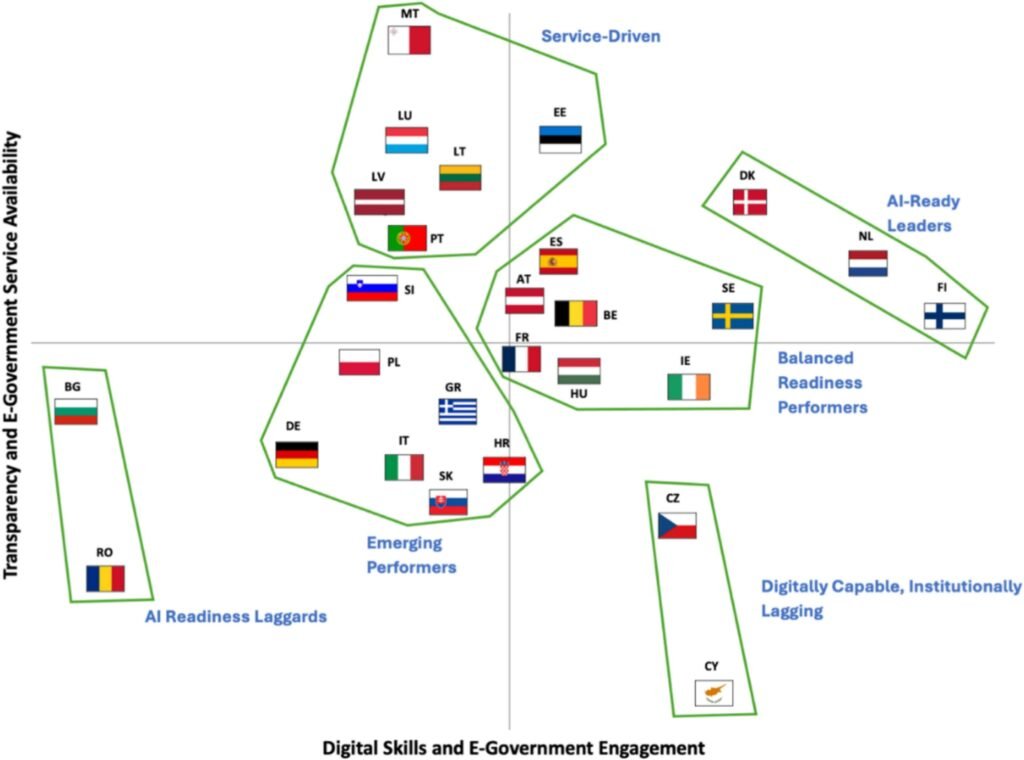
Researchers used secondary data from Eurostat and European Commission e-government reports to assess readiness. Nine indicators were included, such as citizens’ digital skills, the use of e-identification, the online availability of public services, and transparency. These indicators were analysed using factor analysis, which identified two underlying dimensions: digital skills and engagement in e-government, and transparency and availability of e-government services. Based on these dimensions, a cluster analysis was conducted, resulting in six distinct groups of EU member states. The findings reveal a heterogeneous landscape, reflecting different strengths and weaknesses across countries.
Strengths and weaknesses
AI Readiness Laggards
This cluster includes Bulgaria and Romania. These countries exhibit very low levels of digital skills and engagement in e-government, as well as low transparency and service availability. This indicates the presence of systemic barriers in digital infrastructure and citizen capabilities. Their position is consistent with previous analyses of the digital divide in Central and Eastern Europe.
Emerging Performers
This cluster includes Croatia, Germany, Greece, Italy, Poland, Slovakia, and Slovenia. These countries demonstrate moderate levels of digital skills and citizen engagement but comparatively lower levels of institutional transparency and service availability. This suggests that technical capacity alone may not be sufficient. Germany, despite its economic strength, faces challenges related to decentralized governance and the slower adoption of e-identification systems. Slovenia and Poland have introduced initiatives aimed at improving digital skills and expanding the use of digital technologies in public administration.
Service-Driven Countries
This cluster includes Estonia, Latvia, Lithuania, Luxembourg, Malta, and Portugal. These countries show moderate levels of digital readiness, with slightly below-average digital skills but high levels of transparency and service availability. This suggests an emphasis on accessibility and user-oriented service provision. Malta stands out for its particularly strong performance in institutional transparency.
Digitally Capable, Institutionally Lagging
Cyprus and the Czech Republic represent a case of high digital skills combined with low levels of transparency and openness of e-services. This points to governance-related constraints that may hinder effective implementation despite strong citizen capabilities.
AI-Ready Leaders
Denmark, Finland, and the Netherlands perform strongly across both dimensions—digital skills and transparency—indicating a reinforcing relationship between citizen competencies and institutional readiness. These countries rank among the leaders in digital public services and human capital. Denmark has introduced a common ethical framework to guide the use of digital technologies in the public sector, with the aim of strengthening trust in digital services.
Balanced Readiness Performers
This cluster includes Austria, Belgium, France, Hungary, Ireland, Spain, and Sweden. These countries demonstrate balanced performance across both dimensions, consistently above average without extreme variation. While they do not face major deficits, continued investment in digital skills and institutional development remains important for meeting broader EU digital policy objectives.
The desired change is an EU where AI-enabled public services develop more evenly, transparently, and inclusively across all member states
What do you hope the study will contribute to?
The study aims to contribute to a clearer understanding of why EU countries are not equally ready to integrate AI into e-government. Its main contribution is to show that AI readiness is not only about having technology or money, but also about two connected conditions: citizens need enough digital skills and experience using online public services, and governments need transparent, accessible, and mature digital services. By grouping EU countries into different readiness profiles, the study can help policymakers avoid one-size-fits-all digital strategies and design support that matches each country’s actual weaknesses.
In a year or two, what kind of change would you like to see in the EU?
In one or two years, the kind of change we would like to see in the EU is a more targeted and inclusive approach to AI in public services. However, this may be ambitious within such a short timeframe, because transformation in the public sector usually takes more than two years, especially when it involves skills, institutional capacity, trust, and governance reforms. Still, the EU could make visible progress by helping countries with low digital skills and weak e-government use through digital literacy programmes, citizen support, and public-sector AI training. Countries with better digital skills but weaker transparency should improve explainability, openness, and citizen trust in algorithmic public services. More advanced countries should act as knowledge hubs, sharing good practices and supporting joint pilots with less advanced member states. Overall, the desired change is an EU where AI-enabled public services develop more evenly, transparently, and inclusively across all member states.
Limitations and the future
As the study points out, there are also several limitations that need to be acknowledged. “First, the analysis relies on a limited set of nine proxy indicators which, while relevant, cannot fully reflect the multidimensional nature of AI readiness in e-government. This limitation is aggravated by the lack of AI-specific indicators tailored to public service contexts, particularly those that distinguish between readiness, adoption, and actual usage. As a result, important dimensions such as ethics, vision, economy, institutional capacity, or citizen trust remain insufficiently captured. Second, the use of nationally aggregated data limits the ability to assess disparities within countries, such as those based on income, gender, or geographic region, which are known to influence digital inclusion and public service access.”
As the authors conclude, future research should expand the indicator base to include both structural and behavioural variables, ideally disaggregated by key demographic and regional dimensions, while more advanced countries are encouraged to maintain high standards and support knowledge exchange and cooperation across the EU.
Image: Amaral, E., Naranjo-Zolotov, M., & Bação, F. (2025). Unequal AI readiness in EU e-government.
This work was supported by national funds through FCT (Fundação para a Ciência e a Tecnologia), under the project – UID/04152/2025 – Centro de Investigação em Gestão de Informação (MagIC)/NOVA IMS – https://doi.org/10.54499/UID/04152/2025 (2025-01-01/2028-12-31) and UID/PRR/04152/2025 https://doi.org/10.54499/UID/PRR/04152/2025 (2025-01-01/2026-06-30).
